
Google Pixel 9 Pro Fold vs Motorola Razr 40

Google Pixel 9 Pro Fold
See options
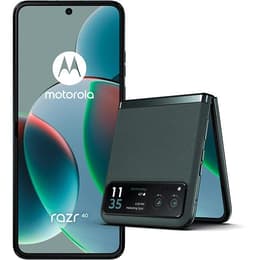
Motorola Razr 40
Motorola Razr 40
See options

Ratings

The Google Pixel 9 Pro Fold, released in September 2024, represents Google's second-generation foldable smartphone, offering a large internal display and a compact folded form factor. The Motorola Razr 40, launched in June 2023, is a clamshell-style foldable designed for portability. Both devices operate on the Android platform, but they cater to different user preferences through their distinct designs, internal specifications, and software approaches.

Scores

Durability

When considering the long-term usability of these foldable devices, several factors come into play, including their release timelines, software support, and physical resilience.

  • Release Timeline and Software Support: The Google Pixel 9 Pro Fold, being a more recent release (September 2024), benefits from a longer expected software support window. Google typically provides extensive operating system and security updates for its Pixel devices, often extending to seven years from the release date. In contrast, the Motorola Razr 40, released in June 2023, is slated to receive up to three major Android OS upgrades and four years of bi-monthly security updates [6, 22, 28, 35]. This difference means the Pixel 9 Pro Fold will likely receive functional and security updates for a significantly longer period.
  • Physical Durability: The Pixel 9 Pro Fold incorporates a stainless steel hinge and an aluminum alloy cover, along with Gorilla Glass Victus 2 on its cover display, contributing to its structural integrity and scratch resistance [4, 18, 25]. It also carries an IPX8 water resistance rating, indicating protection against immersion in water [25]. The Motorola Razr 40 features a plastic front, plastic back, and an aluminum frame with a stainless steel hinge, and its cover display is protected by Gorilla Glass Victus [3, 34]. It has an IP52 water-repellent coating, offering protection against dust and light splashes [3, 34].
  • Repairability: Foldable phones generally present challenges for repair due to their complex designs. The Motorola Razr 40 has been noted to have a repairability score of 4 out of 10, with strong adhesives and intricate internal components making disassembly difficult [10]. While a specific repairability score for the Pixel 9 Pro Fold is not widely available, the advanced engineering in foldable devices often results in lower repairability compared to traditional smartphones.

Release year

2024

2023

Compatible with latest Update

Yes

Yes

Operating system

Android

Android

Foldable

Yes

Yes

Performance

The performance of a smartphone is largely determined by its internal processing capabilities, memory, and how efficiently it manages power for daily tasks.

  • Processing Power: The Google Pixel 9 Pro Fold is equipped with Google's Tensor G4 processor [8, 9]. This system-on-chip is designed to handle demanding applications, advanced computational photography, and on-device artificial intelligence tasks with efficiency. Users can expect smooth multitasking, rapid app loading, and a responsive experience even with graphically intensive games. The Motorola Razr 40 is powered by the Qualcomm Snapdragon 7 Gen 1 processor [1, 3, 13, 14, 16, 17]. This processor provides capable performance for everyday use, including web browsing, social media, and most applications, though it may not match the raw processing power of higher-tier chipsets for the most intensive tasks [16].
  • Memory and Storage: The Pixel 9 Pro Fold comes with 16GB of RAM, allowing for extensive multitasking and seamless switching between numerous open applications [4, 8, 9]. It offers storage options of 256GB and 512GB [4, 8, 9]. The Razr 40 is available with 8GB or 12GB of RAM, which is sufficient for typical smartphone usage and multitasking [1, 3, 13, 14, 17]. Storage configurations include 128GB and 256GB [1, 3, 13, 14, 17].
  • Battery Behavior: The Pixel 9 Pro Fold houses a 4650 mAh battery [8, 9, 18], supporting 45W fast charging [9, 18]. The Motorola Razr 40 features a 4200 mAh battery [1, 3, 5, 13, 17] with support for 30W wired charging and 5W wireless charging [5, 13, 16]. Real-world battery performance can vary based on usage patterns, but both devices aim to provide sufficient power for a full day of moderate use.

Memory (GB)

16 GB

8 GB

Screen quality

The display is a central component of any smartphone, and foldable devices offer unique viewing experiences with their dual-screen configurations.

  • Main Display Technology and Size: The Google Pixel 9 Pro Fold features an 8-inch OLED main display with a resolution of 2076 x 2152 pixels [4, 9, 18, 25]. This large, nearly square display provides an expansive canvas for productivity and media consumption. The Motorola Razr 40's main display is a 6.9-inch pOLED/LTPO AMOLED panel with a resolution of 1080 x 2640 pixels [1, 3, 13, 14, 19, 21, 23, 34]. Its taller aspect ratio is well-suited for scrolling and single-handed use when unfolded.
  • Brightness and Refresh Rate: The Pixel 9 Pro Fold's main and cover displays can reach a peak brightness of 2700 nits, ensuring excellent visibility even in bright outdoor conditions [18, 25]. Its main display offers an adaptive refresh rate ranging from 1Hz to 120Hz, contributing to smooth scrolling and power efficiency [4]. The Razr 40's main display achieves a peak brightness of 1400 nits [3, 13, 14, 19, 23, 34] and supports a refresh rate of up to 144Hz, providing a fluid visual experience [1, 3, 13, 14, 19, 21, 23, 34].
  • Cover Display Functionality: The Pixel 9 Pro Fold includes a 6.3-inch OLED cover display with a 60-120Hz refresh rate, offering a substantial external screen for notifications, quick tasks, and even full app usage without unfolding [4, 25]. The Motorola Razr 40 has a smaller 1.5-inch AMOLED cover display, primarily designed for glanceable information such as time, notifications, and basic controls [3, 14, 23, 34].

Resolution

2076 x 2152

1080 x 2640

Screen type

Foldable LTPO OLED

Foldable LTPO AMOLED

Audiovisual

Camera systems are a key differentiator for modern smartphones, and both devices offer versatile setups for capturing photos and videos.

  • Rear Camera Systems: The Google Pixel 9 Pro Fold features a triple-camera system on the rear, comprising a 48MP wide-angle lens (f/1.7), a 10.5MP ultrawide lens (f/2.2), and a 10.8MP telephoto lens with 5x optical zoom (f/3.1) [4, 9, 18, 25]. This configuration provides flexibility for various photographic scenarios, from expansive landscapes to distant subjects. The Motorola Razr 40 is equipped with a dual-camera setup, including a 64MP main wide-angle lens (f/1.7) with optical image stabilization (OIS) and a 13MP ultrawide lens (f/2.2) that also functions for macro photography [2, 3, 13, 14, 15, 16, 19, 20].
  • Photography Performance: Pixel devices are known for their computational photography, which enhances image quality across different lighting conditions. The Pixel 9 Pro Fold is expected to deliver detailed images with accurate colors and strong low-light performance. The Razr 40's main camera can produce good images in favorable lighting, with natural colors, and OIS assists in low-light situations [2, 14, 15]. However, some users have noted that its camera performance, particularly in challenging conditions, may not match that of higher-end flagship devices [2, 14, 16, 20, 26].
  • Video and Front Cameras: Both devices support 4K video recording at 30 frames per second [2, 3, 14, 15, 16, 20]. The Pixel 9 Pro Fold has a 10MP front camera on both the cover and inner displays [9, 18, 25]. The Razr 40 features a 32MP front-facing camera on its inner display [2, 3, 13, 15, 20]. The foldable form factor allows for creative camera usage, such as using the main rear cameras for high-quality selfies on both devices.

Main camera

48 megapixels

64 megapixels

Front camera

10 megapixels

32 megapixels

Miscellaneous

Beyond core specifications, several practical features contribute to the overall user experience and daily convenience of a smartphone.

  • Connectivity and Ports: Both the Google Pixel 9 Pro Fold and the Motorola Razr 40 support 5G cellular connectivity, ensuring fast mobile data speeds [3]. They also feature modern Wi-Fi standards, with the Razr 40 supporting Wi-Fi 6E [3]. Bluetooth connectivity is present on both for wireless accessories [1, 3]. For physical connections, both devices utilize a USB Type-C port for charging and data transfer [1, 3]. Neither device includes a traditional 3.5mm headphone jack.
  • Biometrics and Sensors: The Pixel 9 Pro Fold incorporates advanced security features, including face recognition and an under-display fingerprint sensor. The Motorola Razr 40 features a side-mounted fingerprint sensor integrated into the power button for convenient unlocking [3, 20]. Both devices include a standard array of sensors such as accelerometers, gyroscopes, and compasses for various functionalities.
  • Design and Handling: The Pixel 9 Pro Fold, when unfolded, presents a larger, tablet-like experience, while folding it makes it more compact, though still substantial in hand. It weighs 257 grams [18]. The Razr 40 emphasizes a compact, pocketable design when folded, reminiscent of classic flip phones. It weighs 188.6 grams [3, 12, 13, 14, 34], making it noticeably lighter than the Pixel 9 Pro Fold. The Razr 40's folded dimensions are 88.2 x 74 x 15.8 mm, and unfolded it measures 170.8 x 74 x 7.4 mm [3, 12, 34]. The Pixel 9 Pro Fold is 5.1mm thin when unfolded and 10.5mm thick when folded [18].

Weight

257 oz

189 oz

Screen size (in)

8.0

6,9

Network

5G

5G

SIM card

Physical SIM + eSIM

Dual Physical SIM + eSIM

Carrier compatibility

Unlocked

Unlocked

User feedback for the Motorola Razr 40 indicates a generally positive reception for its design and the return to a more compact flip phone form factor [27]. Many appreciate its main display quality and the tactile feel of its vegan leather finish [20]. However, common criticisms often revolve around its camera performance, which some users find to be inconsistent or not on par with other devices in its category [20, 26]. Concerns about long-term durability, particularly regarding the folding screen and hinge, have also been raised by some users, though experiences vary [24, 27, 31]. Battery life is generally considered decent for a flip phone, but heavy users might find themselves charging more frequently [26, 32].

For the Google Pixel 9 Pro Fold, user sentiment highlights its large, immersive internal display and the robust performance delivered by its Tensor G4 processor, which excels in AI-driven features and computational photography. Its extended software support is also a significant advantage for users prioritizing longevity. Potential considerations might include its weight and overall size compared to more compact foldable designs, and the inherent durability considerations that come with any large-screen foldable device.

Users prioritizing a large, tablet-like internal display for productivity, media consumption, and advanced computational photography, coupled with long-term software support, may find the Google Pixel 9 Pro Fold well-suited to their needs. Its powerful processor and extensive RAM are ideal for demanding applications and multitasking. Conversely, individuals who value a highly compact and portable device that easily fits into smaller pockets, with a focus on a classic flip phone experience, might lean towards the Motorola Razr 40. Its design offers a distinct aesthetic and a capable experience for everyday tasks. Both devices offer a quality-assured refurbished option, providing an eco-friendly alternative for consumers.


See all articles

Our recent comparisons