
Google Pixel 9 Pro XL vs Motorola Razr 40

Google Pixel 9 Pro XL
Starting at

Refurbished price:A$853.00

Versus A$1,849.00 new

See options
Motorola Razr 40
Motorola Razr 40
See options

Ratings

The Google Pixel 9 Pro XL (released August 2024) and the Motorola Razr 40 (released June 2023) represent distinct approaches to smartphone design and functionality. While the Pixel 9 Pro XL offers a traditional, high-performance slab experience with advanced computational photography, the Razr 40 provides a unique foldable clamshell design focused on portability and a secondary external display. Both devices run on the Android operating system, but they cater to different user preferences through their form factors and core capabilities.

Scores

Durability

When considering the long-term usability of these devices, their release timelines and software support policies are key factors.

  • Release Timeline: The Google Pixel 9 Pro XL, launched in August 2024, benefits from a more recent release, placing it at the forefront of current technology. The Motorola Razr 40, released in June 2023, is over a year older, which impacts its remaining software support window.
  • Software Longevity: Google offers an extensive seven years of operating system and security updates for the Pixel 9 Pro XL, ensuring prolonged software relevance and security. In contrast, the Motorola Razr 40 is slated to receive three major Android OS updates, up to Android 16, and four years of bi-monthly security updates. This means the Pixel 9 Pro XL will maintain software currency for a significantly longer period.
  • Durability and Repairability: The Pixel 9 Pro XL features an IP68 rating for dust and water resistance, indicating a high level of protection against environmental elements. The Razr 40 has an IP52 water-repellent coating, offering a more basic level of protection. The foldable design of the Razr 40 introduces a hinge mechanism, which, while robust, is an additional mechanical component compared to the solid-body design of the Pixel 9 Pro XL.

Release year

2024

2023

Compatible with latest Update

Yes

Yes

Operating system

Android

Android

Foldable

No

Yes

Performance

The performance of a smartphone is crucial for daily tasks, from app usage to demanding games and multitasking.

  • Processor Capabilities: The Google Pixel 9 Pro XL is powered by Google's Tensor G4 processor, designed for flagship-level performance and optimized for artificial intelligence tasks. This allows for smooth handling of demanding applications, complex computations, and efficient on-device AI processing. The Motorola Razr 40 utilizes a current-generation processor, which provides capable performance for everyday use and general multitasking.
  • Multitasking and Responsiveness: With 16 GB of RAM, the Pixel 9 Pro XL offers substantial memory for seamless multitasking, allowing users to switch between numerous applications without noticeable slowdowns. The Razr 40 comes with 8 GB or 12 GB of RAM, which is sufficient for typical smartphone usage, though it may offer less headroom for extremely heavy multitasking compared to the Pixel.
  • Storage and Battery Behavior: The Pixel 9 Pro XL offers a wide range of storage options, up to 1 TB, catering to users with extensive storage needs. The Razr 40 is available with up to 256 GB of storage. The Pixel 9 Pro XL features a 5060 mAh battery, providing extended usage times, with some reports indicating over 18 hours of continuous video playback. The Razr 40 has a 4200 mAh battery, which, combined with its efficient display technology, offers good endurance for a foldable device.

Memory (GB)

16 GB

8 GB

Screen quality

The display is a primary interface for smartphone interaction, and both devices offer distinct visual experiences.

  • Display Technology and Clarity: The Google Pixel 9 Pro XL features a 6.8-inch LTPO OLED display, providing deep blacks, vibrant colors, and excellent contrast. Its resolution of 1344 x 2992 pixels ensures sharp and detailed visuals. The Motorola Razr 40 boasts a 6.9-inch foldable LTPO AMOLED main display with a resolution of 1080 x 2640 pixels, offering a large, immersive viewing area when unfolded.
  • Brightness and Refresh Rate: The Pixel 9 Pro XL's display can reach a peak brightness of 3000 nits, making it highly visible even in bright outdoor conditions. It also features an adaptive refresh rate ranging from 1Hz to 120Hz for smooth scrolling and power efficiency. The Razr 40's main display offers a 144Hz refresh rate for fluid motion and a peak brightness of 1400 nits.
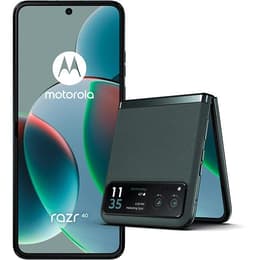
  • Unique Display Features: A key differentiator for the Razr 40 is its 1.5-inch AMOLED cover display, which allows users to view notifications, control music, and take quick selfies without unfolding the phone. The Pixel 9 Pro XL, as a traditional slab phone, focuses on maximizing the main screen experience.

Resolution

1344 x 2992

1080 x 2640

Screen type

LTPO OLED

Foldable LTPO AMOLED

Audiovisual

Both smartphones offer capable camera systems, but with different strengths and features.

  • Rear Camera Systems: The Google Pixel 9 Pro XL features a versatile triple-camera setup on the rear, including a 50 MP main sensor with optical image stabilization (OIS), a 48 MP ultrawide camera with autofocus for macro shots, and a 48 MP telephoto lens offering 5x optical zoom. This comprehensive system is designed for a wide range of photographic scenarios. The Motorola Razr 40 has a dual-camera system, comprising a 64 MP main camera with OIS and a 13 MP ultrawide camera with autofocus.
  • Photography Features and Performance: The Pixel 9 Pro XL leverages Google's advanced computational photography, offering features like Super Res Zoom, Night Sight, Astrophotography, and various AI-powered editing tools. Users can expect detailed images with accurate colors and strong low-light performance. The Razr 40's main camera uses pixel-binning to produce 16 MP images with good detail and realistic colors in favorable lighting. Its ultrawide camera can also be used for macro photography.
  • Video Recording and Audio: The Pixel 9 Pro XL supports video recording up to 4K at 60fps natively, with an innovative Video Boost feature that can upscale videos to 8K resolution using cloud processing. It also includes features like Night Sight Video and Audio Magic Eraser. The Razr 40 records video at 4K at 30fps from both its main and internal cameras. Both devices offer stereo speakers, with the Razr 40 also featuring Dolby Atmos for an enhanced audio experience.

Main camera

50 megapixels

64 megapixels

Front camera

42 megapixels

32 megapixels

Miscellaneous

Beyond core performance and camera, several practical elements contribute to the overall user experience.

  • Connectivity and Ports: Both devices support 5G connectivity for fast mobile data speeds. The Google Pixel 9 Pro XL includes Wi-Fi 6E and Bluetooth 5.3, offering advanced wireless connectivity. The Motorola Razr 40 supports Wi-Fi 6 (ax) and Bluetooth 5.2 or 5.3, depending on the region. The Pixel 9 Pro XL uses a USB Type-C 3.2 port, while the Razr 40 uses a USB Type-C 2.0 port.
  • Biometrics and Sensors: The Pixel 9 Pro XL features an ultrasonic fingerprint sensor embedded under the display, along with a suite of sensors including an accelerometer, gyroscope, proximity sensor, compass, barometer, and a skin temperature thermometer, plus Ultra Wideband (UWB) support and Satellite SOS. The Razr 40 incorporates a side-mounted fingerprint sensor and includes an accelerometer, gyroscope, proximity sensor, and compass.
  • Design and Handling: The Pixel 9 Pro XL is a larger, traditional smartphone with dimensions of 162.8 x 76.6 x 8.5 mm and a weight of 221 grams. Its design prioritizes a large, uninterrupted screen. The Razr 40's foldable design makes it significantly more compact when closed (88.2 x 74 x 15.8 mm), enhancing portability, though it is slightly lighter at 188 grams. When unfolded, its dimensions are 170.8 x 74 x 7.4 mm.

Weight

221 oz

189 oz

Screen size (in)

6.8

6,9

Network

5G

5G

SIM card

Physical SIM + eSIM

Dual Physical SIM + eSIM

Carrier compatibility

Unlocked

Unlocked

The Google Pixel 9 Pro XL and the Motorola Razr 40 cater to different user priorities, each excelling in its respective design philosophy. User sentiment for the Pixel 9 Pro XL often highlights its exceptional camera capabilities, long-lasting battery life, and the promise of extended software support, making it a strong contender for users who prioritize a premium, feature-rich smartphone experience with a focus on photography and longevity. Some users might note its larger size and weight as a consideration, but generally, its performance and software integration are well-received.

The Motorola Razr 40, on the other hand, is praised for its unique foldable form factor, offering enhanced portability and a nostalgic yet modern design. Users appreciate the convenience of the external display for quick interactions and its ability to stand on its own for hands-free use. While its camera system is competent for everyday photography, it may not match the advanced computational photography of the Pixel. Its battery life is considered good for a foldable, though not as extensive as the Pixel 9 Pro XL. The Razr 40 is often seen as a stylish and functional choice for those who value a compact device and the novelty of a folding screen.

Users prioritizing cutting-edge camera technology, top-tier processing power, and the longest possible software support will find the Google Pixel 9 Pro XL well-suited to their needs. Its robust battery and large, bright display also make it ideal for media consumption and productivity. Conversely, individuals who value a highly portable device, a distinctive design, and the practical benefits of a foldable screen, such as the external display for quick glances, may prefer the Motorola Razr 40. Both devices offer a quality-assured refurbished option, providing a sustainable choice for consumers looking to extend the life cycle of electronic products.

See all articles

Our recent comparisons