
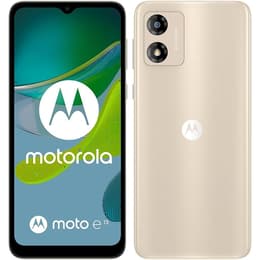

Google Pixel 8a vs Motorola Moto E13

Google Pixel 8a
Google Pixel 8a
Starting at

Refurbished price:A$464.00

Versus A$938.69 new

See options
Motorola Moto E13
Motorola Moto E13
Starting at

Refurbished price:A$121.29

Versus A$244.00 new

See options

Ratings

The Google Pixel 8A, released in May 2024, and the Motorola Moto E13, launched in January 2023, represent distinct segments within the smartphone market. While both are Android devices, the Pixel 8A operates on a full version of Android 14 with a focus on advanced features and extended software support, whereas the Moto E13 runs on Android 13 Go Edition, tailored for more modest hardware. The primary differentiators lie in their processing power, display technology, and camera capabilities, catering to users with varying expectations for performance and features.

Scores

Durability

The longevity of a smartphone is influenced by its release timeline, software support, and physical resilience.

  • Release Timeline & OS Support: The Google Pixel 8A, released in May 2024, benefits from Google's commitment to providing seven years of OS and software updates, extending its functional lifespan significantly. In contrast, the Motorola Moto E13, launched in January 2023, runs on Android 13 Go Edition and typically receives fewer and shorter-term software updates, limiting its practical software longevity.
  • Durability Features: The Pixel 8A features an IP67 rating, indicating strong resistance to dust and the ability to withstand submersion in up to 1 meter of water for 30 minutes. Its display is protected by Corning Gorilla Glass 3. The Moto E13 offers an IP52 rating, providing protection against dust and splashes but not full water immersion. Both devices feature plastic backs, with the Pixel 8A having an aluminum frame.
  • Repairability: The Pixel 8A is designed with repairability in mind, with genuine replacement parts available, contributing to its potential for a longer practical lifespan through maintenance. Information on the Moto E13's repairability is less prominent, suggesting a more standard approach to servicing.

Release year

2024

2023

Compatible with latest Update

Yes

No

Operating system

Android

Android

Foldable

No

No

Performance

Performance is a key area where these two devices diverge, impacting daily usage from app responsiveness to multitasking.

  • Processing Power: The Google Pixel 8A is equipped with a current-generation processor, enabling smooth handling of demanding applications, efficient multitasking, and responsive gaming experiences. Users can expect quick app loading times and fluid navigation. The Motorola Moto E13, powered by a more entry-level processor, is designed for basic tasks and lighter usage. Users may experience slower app launches and less fluid performance, particularly with multiple applications running simultaneously.
  • Memory and Storage: The Pixel 8A comes with 8GB of RAM, facilitating efficient multitasking and app switching without significant slowdowns. It offers storage options of 128GB and 256GB. The Moto E13 is available with various RAM configurations, including 2GB, 4GB, and 8GB, and storage options of 64GB and 128GB. The lower RAM variants of the Moto E13 are better suited for users with minimal app usage.
  • Battery Behavior: The Pixel 8A features a 4492 mAh battery, generally providing a full day of use for many users, with 18W wired and 7.5W wireless charging capabilities. The Moto E13 houses a larger 5000 mAh battery, which, combined with its less demanding hardware and Android Go Edition, often translates to extended usage times between charges, though it supports slower 10W wired charging.

Memory (GB)

8 GB

4 GB

Screen quality

The visual experience on a smartphone is largely defined by its display, with notable differences between these two models.

  • Display Technology and Resolution: The Google Pixel 8A features a 6.1-inch OLED display with a resolution of 2400 x 1080 pixels, delivering deep blacks, vibrant colors, and sharp image clarity. The Motorola Moto E13 has a larger 6.5-inch IPS LCD screen with a resolution of 720 x 1600 pixels, offering a serviceable viewing experience with natural colors, though not matching the contrast or sharpness of an OLED panel.
  • Brightness and Refresh Rate: The Pixel 8A's display can reach a peak brightness of 2000 nits, making it highly visible even in bright outdoor conditions, and supports an adaptive refresh rate of 60-120Hz for smooth scrolling and animations. The Moto E13's display has a standard 60Hz refresh rate and a brightness level that is adequate for indoor use but may require maximum settings for comfortable outdoor viewing.
  • Viewing Experience: Users prioritizing a compact device with a premium, highly responsive, and visually rich display will find the Pixel 8A more suitable. Those who prefer a larger screen for general content consumption and are less concerned with peak brightness or ultra-smooth scrolling may find the Moto E13's display sufficient for their needs.

Resolution

1080 x 2400

720 x 1600

Screen type

OLED

IPS LCD

Audiovisual

Camera performance is a significant consideration for many users, and these devices offer different photographic capabilities.

  • Rear Camera System: The Google Pixel 8A features a dual-camera setup on the rear, including a 64 MP main sensor with optical image stabilization (OIS) and a 13 MP ultrawide lens. This configuration allows for detailed photos, improved low-light performance, and wider landscape shots. The Motorola Moto E13 comes with a single 13 MP rear camera. While capable of decent photos in good lighting conditions, its performance in challenging scenarios like low light is more limited.
  • Front Camera and Video: For selfies, the Pixel 8A has a 13 MP front camera, while the Moto E13 features a 5 MP front camera. Both devices can record video, with the Pixel 8A offering up to 4K resolution at 60fps and various slow-motion options, and the Moto E13 supporting 1080p at 30fps.
  • Software Features and User Experience: The Pixel 8A integrates advanced AI-powered camera features such as Audio Magic Eraser, Best Take, and Magic Editor, enhancing photo quality and offering creative editing possibilities. Users report the Pixel 8A's camera to be class-leading for its segment. The Moto E13's camera app has been noted by users to be slow to launch and process images, which can impact the ability to capture spontaneous moments.

Main camera

64 megapixels

13 megapixels

Front camera

13 megapixels

5 megapixels

Miscellaneous

Beyond core specifications, several practical elements contribute to the overall user experience and device utility.

  • Connectivity and Ports: The Google Pixel 8A supports 5G connectivity, Wi-Fi 6e, and Bluetooth 5.3, offering faster wireless speeds and more stable connections. It features a USB-C 3.2 port but lacks a 3.5mm headphone jack. The Motorola Moto E13 supports 4G LTE, Wi-Fi 802.11 a/b/g/n/ac (dual-band), and Bluetooth 5.0. It includes a USB-C 2.0 port and retains the 3.5mm headphone jack, which can be convenient for users with wired audio accessories. The Moto E13 does not have NFC.
  • Biometric Security: The Pixel 8A offers secure unlocking options with an in-display optical fingerprint sensor and face unlock. The Moto E13 relies on face unlock, which is generally considered less secure, and does not include a fingerprint sensor.
  • Design and Handling: The Pixel 8A has dimensions of 152.1 x 72.7 x 8.9 mm and weighs around 188g, offering a compact and comfortable feel for one-handed use. The Moto E13 is slightly larger and lighter at 164.19 x 74.95 x 8.47 mm and 179.5g, providing a larger screen footprint. Both devices feature a plastic back, with the Pixel 8A having an aluminum frame.

Weight

188 oz

179 oz

Screen size (in)

6.1

6.5

Network

5G

4G

SIM card

Physical SIM + eSIM

Dual Physical SIM

Carrier compatibility

Unlocked

Unlocked

The Google Pixel 8A and Motorola Moto E13 cater to different user needs and priorities, reflecting their distinct positions in the smartphone market.

Users often praise the Pixel 8A for its exceptional camera capabilities, extended software support of seven years, and the inclusion of advanced AI features that enhance the overall user experience. Its vibrant OLED display and smooth performance are also frequently highlighted as strong points. Some common criticisms include its plastic back and the use of an older generation of Gorilla Glass for screen protection.

The Moto E13 is generally lauded for its large battery capacity, which provides reliable endurance for daily tasks, and the inclusion of a 3.5mm headphone jack. However, users frequently note its less powerful processor, which can lead to slower performance, and the basic camera system as areas for improvement. The slower camera app is a particular point of concern for capturing quick moments.

Users prioritizing a device with a high-quality camera, long-term software updates, and a premium display for a fluid and feature-rich experience will find the Google Pixel 8A well-suited to their needs. Its robust performance and AI capabilities make it ideal for those who engage in more demanding tasks and appreciate advanced smartphone features. Conversely, users who primarily need a reliable device for essential communication, basic browsing, and extended battery life, and who prefer a larger screen without requiring top-tier performance or advanced camera features, may lean toward the Motorola Moto E13. It serves as a practical option for those seeking a straightforward smartphone experience.

For consumers looking for a sustainable choice, considering a quality-assured refurbished option for either model can provide an eco-friendly alternative while still meeting specific feature requirements.

See all articles

Our recent comparisons