
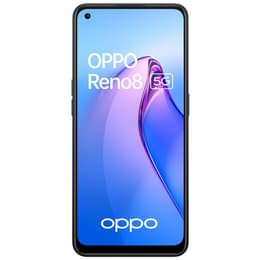

Google Pixel 8 vs Oppo Reno 8

Google Pixel 8
Google Pixel 8
Starting at

Refurbished price:A$463.00

Versus A$1,245.00 new

See options
Oppo Reno 8
Oppo Reno 8
Starting at

Refurbished price:A$246.00

Versus A$1,159.00 new

See options

The Google Pixel 8, released in October 2023, and the Oppo Reno 8, launched in July 2022, are distinct Android smartphones. While both provide solid performance for daily tasks, the Pixel 8 emphasizes advanced computational photography and longer software support. The Reno 8 focuses on a sleek design and fast charging. Both run on the Android operating system, but with different manufacturer-specific interfaces.

Scores

Durability

The longevity and physical resilience of a smartphone are key considerations.

  • Release Timeline and Support: The Google Pixel 8, released in late 2023, benefits from a significantly longer software support window, with Google promising seven years of OS and security updates from its launch. The Oppo Reno 8, released in mid-2022, will likely continue to receive security patches for a few more years, though its major OS update cycle is shorter than the Pixel 8's.
  • Physical Protection: The Pixel 8 features Gorilla Glass Victus 2 on the front and back, alongside an IP68 rating for dust and water resistance, indicating robust protection. The Oppo Reno 8 uses Gorilla Glass 5 on its front display and a glass back, but lacks an official IP rating, suggesting less resistance to dust and water.
  • Expected Lifespan: Users prioritizing extended software longevity and superior physical durability will find the Pixel 8 a more suitable option for a longer practical lifespan. The Reno 8, while durable for everyday use, may see its software support end sooner and offers less protection against water and dust.

Release year

2023

2022

Operating system

Android

Android

Foldable

No

No

Performance

Evaluating smartphone performance involves understanding real-world responsiveness and efficiency.

  • Everyday Responsiveness: The Google Pixel 8, with its newer, custom-designed processor, handles demanding applications, complex multitasking, and graphic-intensive games with smooth and consistent performance. The Oppo Reno 8, equipped with a capable processor from 2022, delivers a responsive experience for daily tasks and moderate gaming, though it may show limitations with the most intensive applications compared to the Pixel 8.
  • Battery Behavior: Both devices feature similar battery capacities, with the Pixel 8 having a 4575 mAh battery and the Reno 8 a 4500 mAh battery. In typical usage scenarios, both phones are generally capable of lasting a full day for most users. The Pixel 8's more efficient processor and software optimizations may offer slightly better endurance under heavy loads.
  • Storage and Multitasking: Both models offer common storage configurations, typically starting at 128GB, sufficient for many users' apps and media. The Pixel 8 generally comes with 8GB of RAM, providing ample capacity for smooth multitasking. The Reno 8 also offers 8GB or 12GB RAM options, ensuring efficient app switching.

Memory (GB)

8 GB

8 GB

Screen quality

The display is a primary interface, and its quality significantly impacts the user experience.

  • Display Technology and Clarity: Both the Google Pixel 8 and the Oppo Reno 8 feature OLED display technology, which provides deep blacks and vibrant colors. Both screens offer a Full HD+ resolution (1080 x 2400 pixels), ensuring sharp text and clear images for everyday viewing.
  • Brightness and Refresh Rate: The Pixel 8's Actua display can reach significantly higher peak brightness levels, up to 2000 nits, making it exceptionally clear and readable even in bright outdoor conditions. It also boasts a smoother 120Hz refresh rate, resulting in more fluid scrolling and animations. The Reno 8's display offers a peak brightness of around 800 nits and a 90Hz refresh rate, which is good for most use, providing a smooth experience.
  • Screen Size and Viewing: The Pixel 8 features a compact 6.2-inch display, making it easier for one-handed use. The Reno 8 offers a slightly larger 6.4-inch screen, which might be preferred by users who consume a lot of video content or prefer more screen real estate.

Resolution

1080 x 2400

1080x2400

Audiovisual

For many users, the camera system is a decisive factor in smartphone choice.

  • Main Camera Capabilities: Both the Google Pixel 8 and the Oppo Reno 8 feature a 50 MP main camera sensor. The Pixel 8 is renowned for its advanced computational photography, enhancing image quality, particularly in challenging lighting conditions, and offers features like Magic Eraser. The Reno 8 also delivers strong daylight photos with good detail and color accuracy.
  • Additional Lenses and Versatility: The Pixel 8 includes a 12 MP ultrawide lens, providing a broader field of view for landscapes and group shots. The Reno 8 offers an 8 MP ultrawide lens and a 2 MP macro lens, adding versatility for close-up photography, though the macro lens's utility is more niche.
  • Video Recording and Front Camera: The Pixel 8 supports video recording up to 4K at 60 frames per second, with advanced stabilization, and has a 10.5 MP front camera suitable for high-quality selfies and video calls. The Reno 8 records video up to 4K at 30 frames per second and features a higher resolution 32 MP front camera, which excels in detailed selfies.

Miscellaneous

Beyond core features, several practical elements contribute to the overall user experience.

  • Connectivity and Ports: The Google Pixel 8 supports the latest Wi-Fi 7 standard and Bluetooth 5.3, offering faster and more reliable wireless connections. It also features a USB-C 3.2 port, enabling quicker data transfer speeds. The Oppo Reno 8 supports Wi-Fi 6 and Bluetooth 5.3, providing solid wireless performance, and includes a USB-C 2.0 port for charging and data transfer.
  • Biometric Security: Both devices incorporate under-display fingerprint sensors for secure and convenient unlocking. The Pixel 8 also offers advanced facial recognition that meets higher security standards, allowing it to be used for secure payments. The Reno 8 also includes face unlock, primarily for convenience.
  • Design and Handling: The Pixel 8 has a more compact form factor, weighing 187g and featuring a refined design with an aluminum frame. The Reno 8 is slightly larger and lighter at 179g, with a glass front and back, and a plastic frame, contributing to a comfortable in-hand feel.

Weight

187 oz

200 oz

Screen size (in)

6.2

6,43

Network

5G

5G

SIM card

Physical SIM + eSIM

Dual Physical SIM

Carrier compatibility

Unlocked

Unlocked

Connector

USB-C

USB-C + Jack 3.5mm

User feedback often highlights the Google Pixel 8's strengths in its camera performance, particularly its computational photography features that consistently produce high-quality images. Users also frequently praise its long-term software support and the clean Android experience. Some common concerns for the Pixel 8 revolve around its battery life under very heavy usage, though for most users, it performs adequately. The Oppo Reno 8 is often commended for its sleek design, fast charging capabilities, and its front camera's ability to capture detailed selfies. Criticisms sometimes point to its shorter software update commitment and the absence of an official IP rating for water resistance.

Users prioritizing a cutting-edge camera system, extended software longevity, and robust physical durability will find the Google Pixel 8 well-suited to their needs. Its advanced processor and brighter display also cater to those seeking a premium and responsive experience. Conversely, users who value a stylish design, a larger screen in a lightweight body, and a strong front-facing camera for selfies may lean towards the Oppo Reno 8. Both devices offer a solid Android experience, and choosing between them often comes down to these specific priorities. For those considering either device, exploring a quality-assured refurbished option can be an eco-friendly alternative.

See all articles

Our recent comparisons