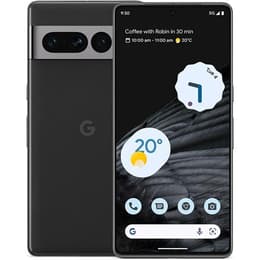

Galaxy S21 5G vs Google Pixel 7 Pro

Galaxy S21 5G
Galaxy S21 5G
Starting at

Refurbished price:A$318.00

Versus A$1,369.00 new

See options
Google Pixel 7 Pro
Google Pixel 7 Pro
Starting at

Refurbished price:A$520.00

Versus A$1,219.00 new

See options

Ratings

The Samsung Galaxy S21 5G, released in January 2021, and the Google Pixel 7 Pro, launched in October 2022, are both prominent Android smartphones. While the Galaxy S21 5G offers a compact design with a focus on a balanced user experience, the Pixel 7 Pro distinguishes itself with advanced camera capabilities and a larger, higher-resolution display. Both devices run on the Android operating system, with each manufacturer providing their distinct user interfaces and software experiences.

Scores

Durability

When considering the long-term usability of these devices, several factors come into play, including their release timelines, software support, and repairability.

  • Release Timeline and Software Support: The Galaxy S21 5G was released in early 2021, while the Pixel 7 Pro followed in late 2022. This difference means the Pixel 7 Pro benefits from a longer period of guaranteed software updates, typically receiving major Android OS updates for three years and security updates for five years from its release. The Galaxy S21 5G, being an earlier model, has received four major OS updates and is expected to continue receiving security updates for a total of five years from its launch.
  • Repairability: The Galaxy S21 5G generally offers a more straightforward repair experience, with a repairability score of 7.5 out of 10, partly due to its easier-to-remove back panel and modular display cable. In contrast, the Pixel 7 Pro has a lower repairability score of 5.5 out of 10, with challenges noted in battery removal due to strong adhesive and a charging port soldered to the motherboard.
  • Expected Practical Lifespan: Both devices are built with durable materials, featuring Gorilla Glass Victus for screen protection. However, the Pixel 7 Pro's newer release date and longer software support window suggest it may remain current with the latest Android features and security patches for a longer duration, potentially extending its practical lifespan for users who prioritize up-to-date software.

Release year

2021

2022

Compatible with latest Update

Yes

Yes

Foldable

No

No

Performance

The performance of these smartphones is influenced by their internal components, affecting everything from app responsiveness to battery endurance.

  • Processor Capabilities: The Galaxy S21 5G is powered by a capable processor from its generation, offering smooth performance for everyday tasks and demanding applications. The Pixel 7 Pro features a newer generation processor designed by Google, which enhances its capabilities in areas like artificial intelligence, machine learning, and image processing, contributing to a responsive user experience.
  • Battery Behavior: The Galaxy S21 5G is equipped with a 4000 mAh battery, providing sufficient power for a full day of moderate use. The Pixel 7 Pro has a larger 5000 mAh battery. However, user experiences vary, with some Pixel 7 Pro users reporting that its higher-resolution display and powerful processor can lead to faster battery drain, especially with heavy usage. Both support fast wired and wireless charging.
  • Storage and Multitasking: The Galaxy S21 5G typically comes with 8GB of RAM and storage options of 128GB or 256GB. The Pixel 7 Pro offers 12GB of RAM, providing more headroom for extensive multitasking and demanding applications, with storage options up to 512GB.

Memory (GB)

8 GB

12 GB

Screen quality

The visual experience on both devices is a key differentiator, with variations in display technology, size, and clarity.

  • Display Technology and Resolution: The Galaxy S21 5G features a 6.2-inch Dynamic AMOLED 2X display with a 1080 x 2400 pixel (FHD+) resolution. The Pixel 7 Pro boasts a larger 6.7-inch LTPO AMOLED display with a higher 1440 x 3120 pixel (QHD+) resolution, resulting in a sharper image with 512 pixels per inch compared to the S21's 421 ppi.
  • Brightness and Refresh Rate: Both phones offer a 120Hz refresh rate for smooth scrolling and animations. The Pixel 7 Pro's LTPO technology allows for an adaptive refresh rate, which can help conserve battery life by adjusting based on content. The Pixel 7 Pro also achieves a higher peak brightness of 1500 nits, making it more visible in bright outdoor conditions compared to the S21 5G's 1300 nits.
  • Viewing Experience: The Pixel 7 Pro's larger screen and higher resolution provide a more immersive viewing experience, particularly for media consumption and detailed content. The Galaxy S21 5G offers a more compact form factor, which some users may find easier for one-handed use. Both displays are protected by Corning Gorilla Glass Victus.

Resolution

1080 x 2400

1440 x 3120

Screen type

Dynamic AMOLED 2X

LTPO AMOLED

Audiovisual

Both smartphones offer advanced camera systems, but they approach photography with different strengths and features.

  • Rear Camera Systems: The Galaxy S21 5G features a versatile triple-camera setup with a 12MP wide, 64MP telephoto (offering 3x hybrid optical zoom), and a 12MP ultrawide lens. The Pixel 7 Pro also has a triple-camera system, including a 50MP wide, 48MP telephoto (with 5x optical zoom and up to 30x Super Res Zoom), and a 12MP ultrawide lens with autofocus, enabling macro photography.
  • Photography Performance: The Pixel 7 Pro is widely praised for its computational photography, delivering consistently excellent photos across various lighting conditions, with strong detail and natural colors. Its low-light performance and zoom capabilities, especially the 5x optical zoom, are notable. The Galaxy S21 5G also captures high-quality images with vibrant colors and good detail, particularly in well-lit environments, and offers 8K video recording.
  • Video and Front Camera: Both devices offer strong video recording capabilities, with the Pixel 7 Pro supporting 4K at 60fps across its main cameras. The Galaxy S21 5G also records up to 8K video. For selfies, the S21 5G has a 10MP front camera, while the Pixel 7 Pro features a 10.8MP front camera, both capable of capturing detailed self-portraits.

Main camera

12 megapixels

50 megapixels

Front camera

10 megapixels

10.8 megapixels

Miscellaneous

Beyond core performance and display, several practical elements contribute to the overall user experience of these devices.

  • Connectivity and Ports: Both phones support 5G connectivity, ensuring access to faster mobile networks. The Pixel 7 Pro supports Wi-Fi 6E and Bluetooth 5.2, offering slightly newer standards than the Galaxy S21 5G's Wi-Fi 6 and Bluetooth 5.0. Both utilize a USB-C port for charging and data transfer and lack a traditional 3.5mm headphone jack.
  • Biometric Security: Both devices feature in-display fingerprint sensors for secure unlocking. The Pixel 7 Pro also includes face unlock functionality.
  • Design and Handling: The Galaxy S21 5G has dimensions of 151.7 x 71.2 x 7.9 mm and weighs 169g, making it a more compact and lighter device. It features an aluminum frame with a plastic back and a Gorilla Glass Victus front. The Pixel 7 Pro is larger and heavier at 162.9 x 76.6 x 8.9 mm and 212g, with an aluminum frame and Gorilla Glass Victus on both the front and back. Both phones carry an IP68 rating for dust and water resistance.

Weight

169 oz

212 oz

Screen size (in)

6.2

67

SIM card

Physical SIM + eSIM

Physical SIM + eSIM

Carrier compatibility

Unlocked

Unlocked

Connector

USB-C

USB-C

User feedback for the Samsung Galaxy S21 5G often highlights its comfortable size, vibrant display, and capable camera system as strong points. Some users have noted that its battery life, while adequate, may not be exceptional for heavy use. The plastic back on the standard S21 model was a point of discussion for some, though it contributes to its lighter weight and potentially better durability against shatters compared to glass. The software experience, with Samsung's One UI, is generally well-regarded for its features and customization.

For the Google Pixel 7 Pro, the camera system consistently receives high praise, particularly for its computational photography, zoom capabilities, and low-light performance. The clean Android experience and timely software updates are also frequently cited as major advantages. However, some users have reported mixed experiences with battery life, despite the larger capacity, and occasional concerns about device heating or cellular connectivity in certain scenarios. The build quality, while premium, has been described by some as feeling less rigid than other flagship devices.

Users prioritizing a more compact and lighter device with a balanced feature set and a generally good repairability score may find the Galaxy S21 5G well-suited to their needs. Those who place a premium on cutting-edge camera performance, a larger and sharper display, and a pure Android software experience with extended update support may lean toward the Pixel 7 Pro. Both devices offer robust performance for daily tasks, and choosing between them often comes down to individual preferences regarding size, camera priorities, and software philosophy. For those considering an eco-friendly and quality-assured option, exploring refurbished versions of either model can be a sustainable choice.


See all articles

Our recent comparisons