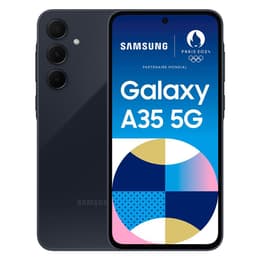


Galaxy A35 vs iPhone 15 Plus

Galaxy A35
Galaxy A35
See options
iPhone 15 Plus
iPhone 15 Plus
Starting at

Refurbished price:A$741.00

Versus A$1,399.00 new

See options

The Samsung Galaxy A35, released in March 2024, and the iPhone 15 Plus, launched in September 2023, are both prominent smartphones designed to cater to different user preferences within their respective ecosystems. While the Galaxy A35 operates on Android with Samsung's One UI, the iPhone 15 Plus runs on Apple's iOS, offering distinct user experiences. A key differentiator lies in their approach to software longevity and display technology, alongside their camera capabilities.

Scores

Durability

When considering the long-term usability and durability of these devices, several factors come into play, including software support, physical resilience, and expected practical lifespan.

  • Software Support: The Samsung Galaxy A35 is committed to receiving four generations of Android OS upgrades and five years of security updates from its release in March 2024. The iPhone 15 Plus, released in September 2023, typically benefits from Apple's longer software support, often extending to five or six years of iOS updates.
  • Physical Durability: The Galaxy A35 features Gorilla Glass Victus+ on its display and an IP67 rating for dust and water resistance, meaning it can withstand submersion in up to 1 meter of fresh water for up to 30 minutes. The iPhone 15 Plus offers a Ceramic Shield front cover and an IP68 rating, allowing for submersion in up to 6 meters of water for the same duration, suggesting a slightly higher degree of water resistance. Both devices are designed to resist damage from everyday spills and dust.
  • Build Materials: The Galaxy A35 incorporates a glass back and a plastic frame, contributing to its overall construction. The iPhone 15 Plus features an aluminum design with a color-infused glass back, providing a different tactile experience.

Release year

2024

2023

Operating system

Android

iOS

Foldable

No

No

Performance

The performance of a smartphone is crucial for daily tasks, from navigating apps to engaging in demanding activities like gaming or video editing.

  • Processing Power: The Galaxy A35 is equipped with an octa-core processor designed to handle multitasking, gaming, and streaming smoothly, supported by an improved GPU and NPU. It also features a large vapor chamber cooling system to manage heat during intensive use. The iPhone 15 Plus is powered by a robust chip that ensures fluid performance across applications, offering responsive interactions and efficient handling of complex tasks.
  • Storage and Multitasking: The Galaxy A35 offers internal storage options of 128GB or 256GB and supports expandable storage via a microSD card up to 1TB, providing flexibility for users with extensive media libraries or large app collections. It comes with 6GB or 8GB of RAM. The iPhone 15 Plus is available with 128GB, 256GB, or 512GB of internal storage, but it does not offer expandable storage. It includes 6GB of RAM, contributing to smooth app switching and background process management.
  • Real-world Responsiveness: Users of the Galaxy A35 generally report reliable performance for moderate gaming and everyday applications, with some noting that more demanding titles require more processing power. The iPhone 15 Plus is known for its consistent and high-level responsiveness, allowing for seamless navigation and efficient execution of various applications.

Memory (GB)

6 GB

6 GB

Screen quality

The display is a primary interface for smartphone interaction, and both devices offer distinct visual experiences.

  • Display Technology and Clarity: The Galaxy A35 features a 6.6-inch Super AMOLED display with a Full HD+ resolution of 1080 x 2340 pixels, delivering vibrant colors and deep blacks. The iPhone 15 Plus boasts a 6.7-inch Super Retina XDR OLED display with a higher resolution of 2796 x 1290 pixels, resulting in sharp and detailed visuals.
  • Brightness and Refresh Rate: The Galaxy A35's display offers a 120Hz refresh rate for smoother scrolling and animations, along with a peak brightness of 1000 nits in High Brightness Mode (HBM) for clear outdoor visibility, enhanced by Vision Booster technology. The iPhone 15 Plus has a standard 60Hz refresh rate but achieves a typical brightness of 1000 nits, a peak HDR brightness of 1600 nits, and an impressive peak outdoor brightness of 2000 nits, ensuring excellent visibility even in direct sunlight.
  • Screen Features: The iPhone 15 Plus incorporates the Dynamic Island, an interactive area around the front camera that displays alerts and live activities, integrating hardware and software. The Galaxy A35 has a circular cutout for its selfie camera.

Resolution

1080x2340

1290 x 2796

Audiovisual

For many users, the camera system is a deciding factor, and both smartphones offer capable setups for capturing photos and videos.

  • Rear Camera System: The Galaxy A35 features a triple-camera setup on the rear, including a 50MP main camera with Optical Image Stabilization (OIS), an 8MP ultra-wide lens, and a 5MP macro lens. The iPhone 15 Plus comes with an advanced dual-camera system, comprising a 48MP main camera with sensor-shift optical image stabilization and a 12MP ultra-wide camera. The 48MP main sensor can also enable a 2x optical zoom effect by cropping the sensor.
  • Photography Performance: The Galaxy A35 performs well in daylight conditions, producing photos with good detail and vibrant colors, though its low-light performance can be improved. The iPhone 15 Plus excels in capturing detailed and color-accurate images in various lighting conditions, including improved low-light performance, thanks to features like Photonic Engine and Smart HDR 5. It also offers next-generation portraits with Focus and Depth Control.
  • Video Recording and Front Camera: Both the front and rear cameras of the Galaxy A35 can record video in 4K at 30 frames per second. It has a 13MP front camera. The iPhone 15 Plus supports 4K Dolby Vision video recording at up to 60 frames per second and includes Cinematic mode for professional-looking video effects. Its 12MP TrueDepth front camera also supports 4K video recording and advanced portrait features.

Miscellaneous

Beyond core features, practical elements like connectivity, ports, and physical design contribute to the overall user experience.

  • Connectivity and Ports: Both devices support 5G connectivity, Wi-Fi 6, and Bluetooth 5.3. The Galaxy A35 features a USB-C 2.0 port and supports NFC for mobile payments. The iPhone 15 Plus also adopts a USB-C port, though it operates at USB 2.0 speeds, and includes NFC with reader mode. Neither device includes a 3.5mm headphone jack.
  • Biometric Security: The Galaxy A35 incorporates an under-display fingerprint sensor for secure unlocking. The iPhone 15 Plus relies on Face ID, Apple's facial recognition system, for secure authentication.
  • Dimensions and Handling: The Galaxy A35 measures 161.7 x 78 x 8.2 mm and weighs 209 grams. The iPhone 15 Plus is slightly more compact and lighter at 160.9 x 77.8 x 7.8 mm and 201 grams. These differences can influence how each device feels in hand and pocket.

Weight

209 oz

201 oz

Screen size (in)

6.6

6.7

Network

5G

5G

SIM card

Physical SIM + eSIM

Physical SIM + eSIM

Carrier compatibility

Unlocked

Unlocked

User sentiment for the Samsung Galaxy A35 often highlights its vivid Super AMOLED display, commendable battery life, and Samsung's commitment to software updates as strong points. Some users note that while its performance is reliable for its segment, it might not match the raw power of higher-end devices, and low-light camera performance could be improved. The iPhone 15 Plus is frequently praised for its exceptional battery life, often lasting up to two days for many users, and its large, bright display. Its camera system is also well-regarded for producing high-quality photos and videos, even without a dedicated telephoto lens. Criticisms are less common but sometimes point to the 60Hz refresh rate as a potential area for improvement compared to some Android counterparts.

Users prioritizing extensive software support and a highly fluid, consistent operating system experience, coupled with industry-leading battery life and a premium build, may find the iPhone 15 Plus well-suited to their needs. Its advanced camera features and robust performance make it a strong contender for those who value photography and overall system responsiveness. Conversely, users who prefer the Android ecosystem, desire expandable storage, appreciate a high refresh rate display, and value a strong commitment to software updates for a mid-range device will likely lean towards the Galaxy A35. It offers a balanced set of features for everyday use, making it a practical choice for many.

For those looking to make an informed and sustainable choice, considering quality-assured refurbished options for either of these models can provide an eco-friendly alternative without compromising on functionality.

See all articles

Our recent comparisons