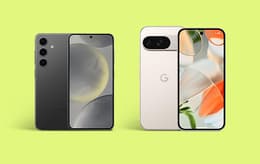
Google Pixel 9 vs iPhone 16 Plus

Google Pixel 9
Google Pixel 9
Starting at

Refurbished price:A$717.00

Versus A$1,349.00 new

See options
iPhone 16 Plus
iPhone 16 Plus
Starting at

Refurbished price:A$942.00

Versus A$1,599.00 new

See options

Ratings

The Google Pixel 9, released in August 2024, and the iPhone 16 Plus, launched in September 2024, represent recent flagship offerings from their respective manufacturers. While both are powerful smartphones designed for everyday use, they diverge in their operating systems and core philosophies. The Pixel 9 emphasizes advanced AI integration and a compact form factor, running on Android 15, whereas the iPhone 16 Plus focuses on a larger display, robust performance, and the iOS ecosystem.

Scores

Durability

When considering the long-term usability of these devices, both the Google Pixel 9 and the iPhone 16 Plus offer substantial software support and physical resilience.

  • Software Longevity: The Google Pixel 9 is expected to receive seven years of software updates, providing extended access to new features and security patches. The iPhone 16 Plus, running iOS 18 at launch, typically receives iOS updates for approximately 5-6 years from its release, with iOS 26.4 being the current version as of March 2026.
  • Physical Durability: Both smartphones feature an IP68 rating for dust and water resistance, allowing submersion in water for a limited time. The Pixel 9 incorporates Gorilla Glass Victus 2 on its front and back for enhanced scratch and drop resistance. The iPhone 16 Plus utilizes Apple's Ceramic Shield on the front, which has shown strong scratch resistance, with faint marks appearing at level 6 on the Mohs scale and deeper grooves at level 7. Both devices have demonstrated good structural integrity in bend tests.
  • Repairability: The iPhone 16 Plus is noted to be potentially easier to repair than its Pro counterparts due to a new electrically de-bonding adhesive on the back.

Release year

2024

2024

Compatible with latest Update

Yes

Yes

Foldable

No

No

Performance

Both the Google Pixel 9 and the iPhone 16 Plus deliver strong performance for daily tasks and demanding applications, though they achieve this through different hardware and software optimizations.

  • Processing Power: The iPhone 16 Plus is equipped with a current-generation processor that provides swift operation and smooth handling of demanding apps and multitasking. Benchmarks indicate strong single-core and multi-core performance, surpassing many Android counterparts. The Pixel 9 features Google's Tensor G4 processor, designed to efficiently manage on-device AI tasks and provide a fluid user experience. Users report the Pixel 9 feels snappy and responsive in everyday use.
  • Multitasking and Storage: The Pixel 9 comes with 12GB of RAM, contributing to smooth multitasking and app management. The iPhone 16 Plus includes 8GB of RAM, which, combined with iOS optimizations, ensures efficient performance across applications. Both devices offer storage options starting at 128GB, with the iPhone 16 Plus also available in 512GB.
  • Battery Performance: The iPhone 16 Plus is recognized for its extended battery life, often lasting a day and a half or even up to three days for lighter users, with up to 27 hours of video playback. The Pixel 9, with its 4700 mAh battery, also offers competitive battery life, with users reporting it comfortably lasting a full day of use.

Memory (GB)

12 GB

8 GB

Screen quality

The display experience on the Google Pixel 9 and iPhone 16 Plus offers distinct characteristics, catering to different preferences in size and visual fluidity.

  • Display Technology and Size: The Google Pixel 9 features a 6.3-inch Actua OLED display with a resolution of 2400x1080 pixels, resulting in a pixel density of 422 ppi. The iPhone 16 Plus sports a larger 6.7-inch Super Retina XDR OLED display with a resolution of 2556 x 1179 pixels and a similar pixel density of 460 ppi.
  • Brightness and Clarity: Both phones offer vibrant visuals with excellent brightness. The Pixel 9's display can reach a typical brightness of 1800 nits and a peak brightness of 2700 nits, ensuring good visibility even in bright outdoor conditions. The iPhone 16 Plus provides 1000 nits of typical brightness, 1600 nits for HDR content, and a peak of 2000 nits.
  • Refresh Rate: The Pixel 9 offers a smooth viewing experience with a 120Hz refresh rate, which dynamically adjusts based on content. In contrast, the iPhone 16 Plus maintains a 60Hz refresh rate, which some users may find less fluid compared to devices with higher refresh rates.

Resolution

1080 x 2424

1290 x 2796

Screen type

OLED

Super Retina XDR OLED

Audiovisual

Both smartphones offer advanced camera systems, each with unique strengths in photography and videography, designed to capture high-quality images and videos in various conditions.

  • Rear Camera System: The Google Pixel 9 features a dual-camera setup with a 50MP main sensor (f/1.68) and a 48MP ultra-wide sensor (f/1.7) with a 123-degree field of view. It includes optical and electronic image stabilization and offers up to 8x digital Super Res Zoom. The iPhone 16 Plus also has a dual-camera system, comprising a 48MP main Fusion camera (f/1.6) with optical image stabilization and a 12MP ultra-wide camera (f/2.2) that doubles as a macro lens. It supports 2x optical zoom using the main sensor and up to 10x digital zoom.
  • Photography Features: The Pixel 9 is praised for its excellent photo quality, particularly in low light, and its AI-powered editing tools. The iPhone 16 Plus introduces a new Camera Control button and Photographic Styles, allowing for real-time adjustments to zoom, exposure, and depth, enhancing the shooting experience. It also supports spatial photo and video capture.
  • Front Camera and Video: For selfies, the Pixel 9 has a 10.5MP front camera, while the iPhone 16 Plus features a 12MP TrueDepth front camera. Both phones are capable of high-quality video recording, with the iPhone 16 Plus noted for its strong video output and improved low-light performance for its ultra-wide camera.

Main camera

50 megapixels

48 megapixels

Front camera

10.5 megapixels

12 megapixels

Miscellaneous

Beyond core performance and display, several practical features and design elements differentiate the Google Pixel 9 and iPhone 16 Plus, impacting daily usability.

  • Connectivity and Ports: Both devices support modern connectivity standards, including 5G and Wi-Fi 7. The iPhone 16 Plus features a USB-C charging port. The Pixel 9 also uses USB-C and supports 15W wireless charging and reverse wireless charging.
  • Biometrics and User Interface: The Pixel 9 incorporates an ultrasonic fingerprint sensor for secure unlocking. The iPhone 16 Plus relies on Face ID for biometric authentication. The iPhone 16 Plus also includes an Action Button, which is customizable for various functions, and a dedicated Camera Control button for enhanced photography interaction.
  • Design and Handling: The Pixel 9 has a more compact design with a 6.3-inch screen and a weight of 198g. Its design is described as feeling premium and solid, with a matte finish on the sides. The iPhone 16 Plus, with its 6.7-inch display, is a larger device, weighing 199g. Its build quality is also considered excellent, with a glass sandwich design and clicky buttons.

Weight

198 oz

199 oz

Screen size (in)

6.3

6.7

Network

5G

5G

SIM card

Physical SIM + eSIM

Physical SIM + eSIM

Carrier compatibility

Unlocked

Unlocked

User feedback for the Google Pixel 9 often highlights its excellent camera capabilities, competitive battery life, and the seamless integration of AI features, making it a strong contender for those who value Google's software ecosystem and computational photography. Some users have noted an initial learning curve for battery optimization and occasional inconsistencies with the fingerprint reader or certain AI features. The design, while refined, has been compared to other popular smartphones.

The iPhone 16 Plus receives praise for its exceptional battery life, often extending beyond a single day of heavy use, and its robust performance for all tasks. Users appreciate the improved camera system, the utility of the new Action Button, and the overall reliability of the iOS experience. A common point of criticism, however, is the 60Hz refresh rate of its display, which some users find less smooth compared to competing devices. Its larger size also means it often requires two hands for comfortable use.

Users prioritizing a compact device with cutting-edge AI features and a high refresh rate display may find the Google Pixel 9 well-suited to their needs. Conversely, individuals who value a larger screen, extended battery life, and the consistent performance of the iOS ecosystem might lean towards the iPhone 16 Plus. Both devices offer a quality-assured refurbished option, providing an eco-friendly alternative for consumers.
See all articles

Our recent comparisons