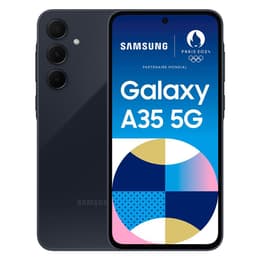

Galaxy A35 vs iPhone 16 Plus

Galaxy A35
Galaxy A35
See options
iPhone 16 Plus
iPhone 16 Plus
Starting at

Refurbished price:A$942.00

Versus A$1,599.00 new

See options

The Samsung Galaxy A35, released in March 2024, and the iPhone 16 Plus, launched in September 2024, represent distinct offerings in the smartphone market. While the Galaxy A35 operates on the Android platform, the iPhone 16 Plus runs on Apple's iOS, providing different user experiences and ecosystems. These devices cater to varying user preferences, primarily differing in their core performance capabilities, camera systems, and software longevity.

Scores

Durability

The practical lifespan and resilience of a smartphone are key considerations for many users, influenced by factors like software support and physical construction.

  • Release timeline and age: The Galaxy A35 was released in March 2024, making it approximately two years old by early 2026. The iPhone 16 Plus, launched in September 2024, is a newer device, having been on the market for about a year and a half. This difference in release dates impacts their expected software support windows.
  • OS support duration and update frequency: Samsung typically provides four years of major Android OS updates and five years of security updates for its A-series devices, meaning the Galaxy A35 can expect support until around 2028 for OS and 2029 for security. Apple, known for its extended software support, generally offers five to six years or more of iOS updates for its iPhones, positioning the iPhone 16 Plus to receive updates well into the early 2030s.
  • Build materials and protection: The Galaxy A35 features a glass front protected by Gorilla Glass Victus+ and an IP67 rating for dust and water resistance. The iPhone 16 Plus incorporates Apple's Ceramic Shield front cover and an IP68 rating, offering enhanced protection against dust and water immersion. Both devices are designed to withstand daily use, but the iPhone 16 Plus offers a slightly higher degree of ingress protection.

Release year

2024

2024

Foldable

No

No

Performance

The responsiveness and capability of a smartphone's internal components dictate its ability to handle various tasks, from everyday browsing to demanding applications.

  • Everyday task handling: The Galaxy A35 is equipped with a capable mid-range processor that handles daily applications, web browsing, and social media with smooth performance. It is well-suited for general use and moderate multitasking, though some users have noted slight lag when launching certain apps or switching between many applications.
  • Demanding applications and gaming: The iPhone 16 Plus features a high-performance processor designed for demanding applications and graphics-intensive games. Users will experience very fluid performance, quick app launches, and seamless transitions, even with multiple complex applications running simultaneously.
  • Storage and multitasking: Both devices offer various storage configurations, allowing users to choose based on their needs for apps, photos, and videos. The iPhone 16 Plus typically includes more RAM, which contributes to its ability to manage a greater number of active applications without slowdowns, benefiting users who frequently switch between apps.

Memory (GB)

6 GB

8 GB

Screen quality

The display is a primary interface for smartphone interaction, influencing visual experience through its technology, resolution, and responsiveness.

  • Display technology and clarity: The Galaxy A35 features a 6.6-inch Super AMOLED display, known for its vibrant colors and deep blacks, providing a clear viewing experience for media consumption and daily tasks. The iPhone 16 Plus comes with a 6.7-inch Super Retina XDR OLED display, which also delivers excellent contrast, color accuracy, and sharpness, making text and images appear crisp.
  • Refresh rate and smoothness: The Galaxy A35 offers a 120Hz refresh rate, which results in noticeably smoother scrolling and more fluid animations, enhancing the overall user interaction. The iPhone 16 Plus typically maintains a standard 60Hz refresh rate, which is sufficient for most users but does not offer the same level of visual fluidity as a higher refresh rate display.
  • Brightness and outdoor visibility: Both displays offer good brightness levels for indoor use. The iPhone 16 Plus generally achieves higher peak brightness, which can improve visibility and readability in bright outdoor conditions, making it more comfortable for use under direct sunlight. The Galaxy A35 also offers good outdoor visibility with up to 1000 nits peak brightness.

Resolution

1080x2340

1290 x 2796

Audiovisual

For many users, the camera system is a crucial factor in smartphone choice, capturing memories and content with varying levels of detail and versatility.

  • Main camera capabilities: The Galaxy A35 features a 50-megapixel main camera with optical image stabilization (OIS), capable of capturing detailed photos in good lighting and respectable images in challenging conditions. The iPhone 16 Plus includes a 48-megapixel main camera with advanced sensor technology and OIS, excelling in detail, dynamic range, and low-light performance, often producing images with natural color reproduction.
  • Additional lenses and versatility: The Galaxy A35 includes an 8-megapixel ultrawide lens and a 5-megapixel macro lens, offering versatility for different photographic scenarios. The iPhone 16 Plus typically features a 12-megapixel ultrawide lens, which provides a wider field of view with strong image quality, particularly in well-lit environments.
  • Video recording and computational photography: Both devices support 4K video recording. The iPhone 16 Plus is recognized for its advanced video capabilities, including features like Cinematic Mode and superior video stabilization, making it a strong choice for users who frequently record high-quality video. Its computational photography also enhances image processing for consistent results across various scenes.

Miscellaneous

Beyond core features, several practical elements contribute to the overall user experience, including connectivity, physical ports, and biometric security.

  • Connectivity and wireless standards: Both the Galaxy A35 and iPhone 16 Plus support 5G connectivity for fast mobile data speeds, along with modern Wi-Fi standards for reliable wireless internet access. The iPhone 16 Plus supports Wi-Fi 7, offering potentially faster and more stable connections. They also include Bluetooth for connecting accessories.
  • Charging and port types: The Galaxy A35 uses a USB-C port for charging and data transfer, a widely adopted standard. The iPhone 16 Plus also features a USB-C port, offering universal compatibility, though its data transfer speeds are typically limited to USB 2.0. Both support fast charging, with the iPhone 16 Plus also supporting faster MagSafe wireless charging.
  • Biometric security and handling: The Galaxy A35 incorporates an in-display fingerprint sensor for secure unlocking. The iPhone 16 Plus relies on Face ID, an advanced facial recognition system. In terms of physical design, the Galaxy A35 weighs approximately 209g, while the iPhone 16 Plus is slightly lighter at around 199g, impacting how each device feels in hand. The iPhone 16 Plus also features an Action Button and a Camera Control button for quick access to functions.

Weight

209 oz

199 oz

Screen size (in)

6.6

6.7

Network

5G

5G

SIM card

Physical SIM + eSIM

Physical SIM + eSIM

Carrier compatibility

Unlocked

Unlocked

Users frequently praise the Galaxy A35 for its vibrant 120Hz AMOLED display and its robust battery life, often noting that it comfortably lasts a full day of moderate to heavy use. Some common criticisms revolve around its mid-range processor, which, while capable, may not satisfy users seeking top-tier performance for intensive gaming or demanding applications. The camera system is generally considered good for its segment, though not on par with flagship devices, and some users have noted thick display bezels.

The iPhone 16 Plus is often lauded by users for its exceptional overall performance, consistently smooth iOS experience, and its highly capable camera system, which delivers reliable results across various lighting conditions and excels in video recording. Users also appreciate its long-term software support and premium build quality. A frequent point of discussion, however, is the standard 60Hz refresh rate on the Plus model, which some users find less fluid compared to devices with higher refresh rates. Initial reports of camera app glitches and frozen screens were largely addressed with software updates.

Users prioritizing a smooth visual experience with a high refresh rate display and extended battery life for everyday tasks may find the Galaxy A35 well-suited to their needs, especially if they prefer the Android ecosystem. Conversely, users who value top-tier performance, a highly refined camera system, and long-term software updates within the iOS ecosystem will likely lean toward the iPhone 16 Plus. Both devices are available as quality-assured refurbished options, providing an eco-friendly alternative for consumers. The choice ultimately depends on individual priorities regarding operating system preference, performance demands, and specific feature requirements.


See all articles

Our recent comparisons