Compare models
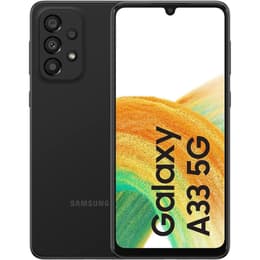
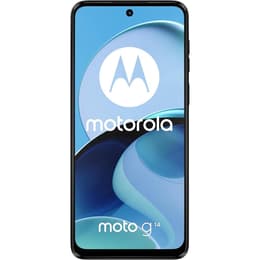
Galaxy A33 5G vs Motorola Moto G14
- 1-year warranty
- Free standard shipping
- Free 30-day returns
Differences at a glance
The Samsung Galaxy A33 5G, released in March 2022, and the Motorola Moto G14, launched in August 2023, are both smartphones designed for everyday use. While the Galaxy A33 5G offers a vibrant AMOLED display and 5G connectivity, the Moto G14 provides a larger LCD screen and a more recent release date. Both devices operate on the Android platform, though they differ in their software update commitments and core hardware.
Available Models
Colour
Storage (GB)
Scores
Durability
The longevity of a smartphone is influenced by its release timeline, software support, and physical durability features.
- Release Timeline and OS Support: The Galaxy A33 5G, released in March 2022, benefits from Samsung's commitment to provide four generations of Android OS upgrades and five years of security updates, extending its software relevance significantly. In contrast, the Moto G14, launched in August 2023, is expected to receive one major OS update (to Android 14) and three years of security updates, offering a shorter guaranteed software lifespan.
- Physical Durability: The Galaxy A33 5G features an IP67 rating for dust and water resistance, meaning it can withstand immersion in up to 1 meter of water for 30 minutes, and its display is protected by Corning Gorilla Glass 5. The Moto G14 has a water-repellent design, which offers protection against splashes but lacks an official IP rating, and its screen uses Panda Glass for protection.
- Repairability: The Galaxy A33 5G has a repairability score of 7.75 out of 10, indicating a relatively straightforward disassembly process for repairs. The Moto G14, however, has a lower repairability score of 5.0 out of 10, suggesting that repairs might be more complex due to the use of adhesive and the need to disassemble multiple components.
Release year
2022
2023
Compatible with latest Update
Yes
Yes
Operating system
Android
Android
Foldable
No
No
Performance
Performance in daily use is shaped by the internal components, affecting app responsiveness and multitasking capabilities.
- Processor Capabilities: The Galaxy A33 5G is equipped with an octa-core processor, which users generally find capable for everyday tasks, though some have noted occasional delays or stutters when many applications are open simultaneously. The Moto G14 also features an octa-core processor, described as capable for most tasks, but some users have reported performance and scrolling issues after a recent Android update, despite a subsequent hotfix.
- Memory and Storage: The Galaxy A33 5G offers multiple RAM configurations, including 4GB, 6GB, and 8GB, alongside 128GB or 256GB of internal storage, which is expandable via a microSD card. The Moto G14 typically comes with 4GB of RAM and 128GB of internal storage, also expandable with a microSD card.
- Overall Responsiveness: The Galaxy A33 5G's 90Hz display contributes to a smoother visual experience during navigation and app usage. The Moto G14, with its 60Hz display, provides a standard level of smoothness, though some users have expressed a desire for a higher refresh rate.
Screen quality
The display is a primary interface for user interaction, with technology, resolution, and refresh rate influencing the visual experience.
- Display Technology and Clarity: The Galaxy A33 5G features a 6.4-inch Super AMOLED display, known for its deep blacks and vibrant color reproduction, offering a clear and sharp viewing experience with a 1080 x 2400 pixel resolution. The Moto G14 comes with a 6.5-inch IPS LCD display, also with a 1080 x 2400 pixel resolution, which provides respectable sharpness and colors, though it may not offer the same contrast levels as an AMOLED panel.
- Refresh Rate and Brightness: The Galaxy A33 5G boasts a 90Hz refresh rate, contributing to smoother scrolling and a more fluid user interface. It also offers a maximum brightness of 800 nits, enhancing visibility in various lighting conditions. The Moto G14 has a standard 60Hz refresh rate, and while its display is bright, it does not reach the same peak brightness levels as the A33 5G.
- Screen Protection: The Galaxy A33 5G's display is protected by Corning Gorilla Glass 5, offering a degree of resistance against scratches and minor impacts. The Moto G14 utilizes Panda Glass for its screen protection.
Resolution
1080 x 2400
1080 x 2400
Screen type
Super AMOLED
IPS LCD
Audiovisual
Camera capabilities and audio output are key considerations for capturing memories and consuming multimedia.
- Camera System: The Galaxy A33 5G features a versatile quad-camera setup on the rear, including a 48MP main lens with optical image stabilization (OIS), an 8MP ultrawide, a 5MP macro, and a 2MP depth sensor. Its front camera is 13MP. The Moto G14 has a dual-camera system with a 50MP main sensor and a 2MP macro lens, along with an 8MP front camera.
- Photography Performance: The Galaxy A33 5G's main camera is noted for producing good and detailed photos in daylight, with OIS aiding in stable shots and video recording up to 4K at 30fps. The Moto G14's 50MP main camera delivers sharp and detailed daylight shots and includes a dedicated Night mode, though low-light performance can be grainy. It records video at 1080p at 30fps.
- Audio Experience: Both the Galaxy A33 5G and the Moto G14 are equipped with stereo speakers and support Dolby Atmos, enhancing the audio experience for media consumption.
Main camera
48 megapixels
50 megapixels
Front camera
13 megapixels
8 megapixels
Miscellaneous
Beyond core features, practical elements like connectivity, ports, and physical design contribute to the overall user experience.
- Connectivity and Ports: The Galaxy A33 5G supports 5G networks, offering faster mobile data speeds, and includes Wi-Fi 5 (ac) and Bluetooth 5.1. It features a USB-C port but omits a 3.5mm headphone jack. The Moto G14 is limited to 4G connectivity but includes Wi-Fi 5 (ac) and Bluetooth 5.0. It retains a 3.5mm headphone jack alongside its USB-C port.
- Biometric Security: For unlocking and security, the Galaxy A33 5G integrates an optical fingerprint sensor directly into its display. The Moto G14 features a side-mounted fingerprint sensor, often integrated into the power button.
- Design and Handling: The Galaxy A33 5G measures 159.7 x 74 x 8.1 mm and weighs 186g, featuring a plastic frame and back with a Gorilla Glass 5 front. The Moto G14 is slightly larger but lighter at 161.5 x 73.8 x 8 mm and 177g, with a plastic body that sometimes offers a textured 'vegan leather' finish.
Weight
186 oz
177 oz
Screen size (in)
6.4
6.5
Network
5G
4G
SIM card
Physical SIM
Dual Physical SIM
Carrier compatibility
Unlocked
Unlocked
What the community thinks
User feedback indicates that the Samsung Galaxy A33 5G is often praised for its vibrant AMOLED display, reliable battery life, and the inclusion of optical image stabilization in its main camera, which enhances photo and video quality. Its extended software support policy is also a significant advantage for users seeking long-term device relevance. Some users, however, have noted that its performance can feel less fluid when handling multiple demanding applications.
The Motorola Moto G14 receives positive remarks for its satisfactory battery life, clean Android software experience, and the presence of stereo speakers with Dolby Atmos. Its main camera performs well in good lighting conditions. Criticisms often point to its 60Hz LCD display, which doesn't offer the same visual fluidity or contrast as AMOLED panels, and its lack of 5G connectivity. Some users also reported initial performance concerns following an Android 14 update, though a hotfix was released.
Users prioritizing a vibrant display, superior camera stability, and longer software support may find the Galaxy A33 5G to be a more suitable option. Conversely, those who value a larger screen, a traditional headphone jack, and a more recent release date might lean towards the Moto G14. Both devices offer distinct advantages, catering to different user needs. For those considering either model, exploring quality-assured refurbished options can provide an eco-friendly alternative.