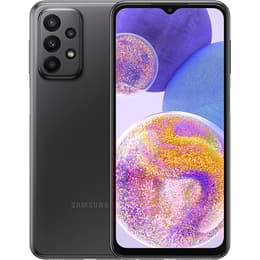
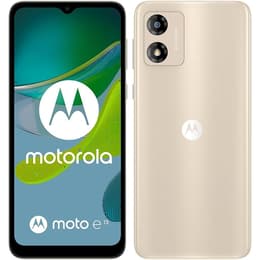

Galaxy A23 vs Motorola Moto E13

Galaxy A23
Galaxy A23
See options
Motorola Moto E13
Motorola Moto E13
Starting at

Refurbished price:A$121.29

Versus A$244.00 new

See options

Ratings

The Samsung Galaxy A23, released in March 2022, and the Motorola Moto E13, launched in January 2023, are both smartphones designed for everyday use. While both devices offer a large display and a substantial battery, they cater to slightly different user expectations through their hardware and software approaches. The Galaxy A23 generally provides a more robust feature set, including a higher-resolution display and a more versatile camera system, while the Moto E13 focuses on essential smartphone functionalities with its Android Go Edition operating system.

Scores

Durability

When considering the long-term usability of these devices, their release timelines and software support policies are key factors.

  • Release and Software Support: The Samsung Galaxy A23 was released in March 2022, while the Motorola Moto E13 followed in January 2023. The Galaxy A23 launched with Android 12 and is eligible for two major Android OS upgrades, potentially reaching Android 14, along with four years of security updates. In contrast, the Moto E13 launched with Android 13 Go Edition and has not received major Android updates since its release, meaning its software longevity is more limited.
  • Repairability: The Galaxy A23 has a repairability score of 6.75 out of 10, indicating a reasonable ease of repair for components like the battery and back cover. The Moto E13 has a slightly lower repairability score of 6.5 out of 10, with some components requiring more extensive disassembly for screen replacement.
  • Practical Lifespan: Users can expect the Galaxy A23 to receive software support for a longer duration, potentially extending its practical lifespan for those who value up-to-date features and security. The Moto E13, with its more limited update policy, may see its practical lifespan constrained by outdated software sooner.

Release year

2022

2023

Compatible with latest Update

Yes

No

Operating system

Android

Android

Foldable

No

No

Performance

The performance of a smartphone directly impacts daily user experience, from app responsiveness to multitasking capabilities.

  • Processing Power: The Samsung Galaxy A23 is equipped with an octa-core processor that handles everyday applications and moderate multitasking with reasonable efficiency. The Motorola Moto E13 features an octa-core processor designed for essential tasks, but users have reported it can struggle with demanding applications and extensive multitasking.
  • Multitasking and Responsiveness: The Galaxy A23 offers various RAM configurations, including 4GB, 6GB, and 8GB, which contribute to smoother transitions between apps and more consistent performance during heavier use. The Moto E13, available with 2GB, 4GB, or 8GB of RAM, particularly in its lower RAM configurations, may exhibit noticeable slowdowns and app crashes when multiple applications are open or during prolonged use.
  • Storage Options: Both devices offer 64GB or 128GB of internal storage, with expandable storage via microSD cards. The Galaxy A23 supports microSD cards, while the Moto E13 can expand storage up to 1TB, providing ample space for media and applications on both.

Memory (GB)

4 GB

4 GB

Screen quality

The display is a primary interface for smartphone interaction, and its quality significantly influences the viewing experience.

  • Display Technology and Resolution: The Samsung Galaxy A23 features a 6.6-inch PLS LCD display with a resolution of 1080x2408 pixels, offering clear and detailed visuals. The Motorola Moto E13 has a 6.5-inch IPS LCD display with a resolution of 720x1600 pixels, which provides adequate clarity for general use but less sharpness compared to the Galaxy A23.
  • Refresh Rate and Smoothness: A notable difference is the refresh rate; the Galaxy A23 boasts a 120Hz refresh rate, contributing to smoother scrolling and a more fluid visual experience. The Moto E13 comes with a standard 60Hz refresh rate, which is sufficient for most tasks but does not offer the same level of visual fluidity.
  • Brightness and Outdoor Visibility: The Galaxy A23's display, protected by Corning Gorilla Glass 5, generally offers good brightness, making it suitable for outdoor viewing, though some users report struggles in direct sunlight. The Moto E13's display provides standard brightness levels, which may be less optimal in bright outdoor conditions.

Resolution

1080 x 2408

720 x 1600

Screen type

PLS LCD

IPS LCD

Audiovisual

Camera capabilities are a significant consideration for many users, impacting the quality of photos and videos captured.

  • Rear Camera System: The Samsung Galaxy A23 features a versatile quad-camera setup on the rear, including a 50-megapixel main sensor with optical image stabilization (OIS), a 5-megapixel ultrawide lens, and two 2-megapixel sensors for macro and depth. This configuration allows for a range of photographic options. The Motorola Moto E13 has a single 13-megapixel rear camera.
  • Photography Performance: The Galaxy A23 generally produces decent photos in good lighting conditions, with the OIS contributing to clearer images. However, its low-light performance can be grainy. The Moto E13's camera is considered basic, with users reporting slow launch times and underwhelming image quality, particularly in challenging lighting.
  • Video Recording and Front Camera: Both devices support video recording up to 1080p. For selfies and video calls, the Galaxy A23 includes an 8-megapixel front camera, while the Moto E13 features a 5-megapixel front camera.

Main camera

50 megapixels

13 megapixels

Front camera

8 megapixels

5 megapixels

Miscellaneous

Beyond core specifications, several practical elements contribute to the overall user experience and device utility.

  • Connectivity and Ports: Both the Galaxy A23 and Moto E13 support 4G connectivity, dual-band Wi-Fi, and Bluetooth 5.0. They both include a USB-C 2.0 port for charging and data transfer, and a 3.5mm headphone jack, offering traditional audio connectivity.
  • Biometric Security and Sensors: The Galaxy A23 features a fingerprint sensor for secure unlocking. The Moto E13 lacks a fingerprint sensor, relying instead on less secure face recognition or traditional PIN/pattern methods. The Moto E13 also notably lacks a gyroscope, which can affect certain applications and games.
  • Build Materials and Durability Features: The Galaxy A23 has a plastic frame and back, with its display protected by Corning Gorilla Glass 5. It does not have an official IP rating for water and dust resistance. The Moto E13 also features a plastic build but comes with an IP52 rating for dust and splash resistance, offering a basic level of protection against environmental elements.

Weight

195 oz

179 oz

Screen size (in)

6.6

6.5

Network

4G

4G

SIM card

Dual Physical SIM

Dual Physical SIM

Carrier compatibility

Unlocked

Unlocked

The Samsung Galaxy A23 and Motorola Moto E13 offer distinct experiences for users seeking a smartphone. The Galaxy A23 is often praised for its vibrant display with a high refresh rate, a more capable camera system with OIS, and a longer software support window. However, some users have noted occasional lag in the user interface and a plastic build that lacks an official IP rating.

Conversely, the Motorola Moto E13 is recognized for its large battery and basic splash resistance. Criticisms frequently revolve around its performance, with reports of sluggishness, app crashes, and a slow camera experience. Its Android Go Edition operating system, while optimized for lower-end hardware, also means a more limited feature set and update schedule.

Users prioritizing a smoother visual experience, better camera versatility, and extended software updates may find the Samsung Galaxy A23 more aligned with their needs. For those who require a device primarily for essential communication and light usage, and value basic splash protection, the Motorola Moto E13 could be a consideration. Both devices are available as quality-assured refurbished options, providing an eco-friendly alternative for consumers.

See all articles

Our recent comparisons