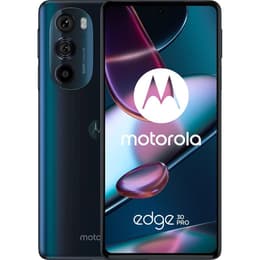
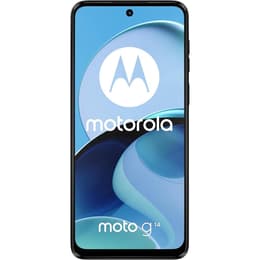

Motorola Edge 30 Pro vs Motorola Moto G14

Motorola Edge 30 Pro
Starting at

Refurbished price:A$291.72

Versus A$2,709.00 new

See options
Motorola Moto G14
Motorola Moto G14
Starting at

Refurbished price:A$182.00

Versus A$271.00 new

See options

The Motorola Edge 30 Pro, released in February 2022, and the Motorola Moto G14, launched in August 2023, represent different segments of the smartphone market. While both devices operate on the Android platform, the Edge 30 Pro is positioned as a higher-performance option with advanced display and camera capabilities, whereas the Moto G14 focuses on delivering essential smartphone features.

Scores

Durability

The expected practical lifespan of a smartphone is influenced by its initial release date, software support, and physical durability.

  • Release Timeline: The Motorola Edge 30 Pro was released in February 2022, making it an older device compared to the Moto G14, which launched in August 2023. This difference in release dates impacts their respective software support cycles.
  • OS Support: The Edge 30 Pro launched with Android 12 and was promised two major OS updates, bringing it up to Android 14, along with three years of security updates. The Moto G14, starting with Android 13, is guaranteed one OS update to Android 14 and three years of bi-monthly security updates. This means the Moto G14, despite being newer, may receive fewer major Android version upgrades than the Edge 30 Pro.
  • Durability Features: Both devices feature a water-repellent design with an IP52 rating, offering protection against splashes. The Edge 30 Pro incorporates Gorilla Glass 3 on both its front and back, while the Moto G14 uses Panda Glass for its front display and a plastic back. Some users have reported the Edge 30 Pro to be fragile, with screens shattering easily after drops.

Release year

2022

2023

Compatible with latest Update

Yes

Yes

Operating system

Android

Android

Foldable

No

No

Performance

Performance varies significantly between these two Motorola smartphones, impacting how smoothly they handle daily tasks and demanding applications.

  • Processing Power: The Edge 30 Pro is equipped with a powerful processor designed for demanding tasks, allowing it to run games and heavy applications smoothly. Users report a very fluid smartphone experience with no noticeable lag, even with a 144Hz refresh rate. The Moto G14 features a processor suitable for basic day-to-day tasks, but it may experience slower app launches and occasional slowdowns during multitasking or graphic-intensive gaming.
  • Multitasking and Responsiveness: The Edge 30 Pro, with its higher RAM options (8GB/12GB), handles multitasking effectively, keeping multiple apps open in the background without issues. The Moto G14, typically with 4GB of RAM, may slow down when several applications are open simultaneously.
  • Storage Options: The Edge 30 Pro offers various internal storage configurations up to 512GB. The Moto G14 comes with 128GB of internal storage, which can be expanded up to 1TB using a microSD card.

Memory (GB)

8 GB

4 GB

Screen quality

The display technology and specifications differ considerably, offering distinct visual experiences on each device.

  • Display Technology and Refresh Rate: The Edge 30 Pro features a 6.7-inch OLED display with a high 144Hz refresh rate, providing deep blacks, vibrant colors, and exceptionally smooth scrolling and animations. The Moto G14 has a 6.5-inch IPS LCD screen with a standard 60Hz refresh rate, offering respectable sharpness and colors, though not as rich or vivid as an OLED panel.
  • Resolution and Clarity: Both phones offer Full HD+ resolution (1080x2400 pixels), resulting in clear and sharp visuals for typical viewing. The Edge 30 Pro also supports HDR10+ for enhanced contrast and color in compatible content.
  • Brightness and Outdoor Visibility: The Edge 30 Pro's OLED screen provides good minimum and maximum brightness, though some users note that visibility in direct sunlight could be improved compared to some competitors. The Moto G14's display is generally bright, and sunlight legibility is considered good for its category.

Resolution

1080 x 2400

1080 x 2400

Screen type

OLED

IPS LCD

Audiovisual

The camera systems on the Motorola Edge 30 Pro and Moto G14 cater to different photography needs and expectations.

  • Rear Camera Setup: The Edge 30 Pro features a versatile triple-camera system with a 50 MP main sensor with optical image stabilization (OIS), a 50 MP ultrawide sensor, and a 2 MP depth sensor. The Moto G14 has a dual-camera setup, including a 50 MP main sensor and a 2 MP macro lens.
  • Photography Performance: The Edge 30 Pro's main camera produces good results in daylight with correct saturation, exposure, and detail, and fast focus. However, some users have criticized its camera performance, particularly in low light, describing photos as grainy and noisy, and the ultrawide camera as lacking detail. The Moto G14's rear camera takes decent pictures, suitable for social media, though colors may appear slightly dull, and the selfie camera can overexpose in bright conditions.
  • Front Camera and Video: The Edge 30 Pro boasts a high-resolution 60 MP front camera and supports video recording up to 8K. The Moto G14 includes an 8 MP front camera and records video at 1080p.

Main camera

50 megapixels

50 megapixels

Front camera

60 megapixels

8 megapixels

Miscellaneous

Beyond core specifications, several practical elements differentiate the user experience of these two devices.

  • Connectivity and Ports: The Edge 30 Pro supports 5G networks, Wi-Fi 6E, and Bluetooth 5.2, offering faster wireless speeds. It lacks a 3.5mm headphone jack. The Moto G14 supports 4G LTE, Wi-Fi 5, and Bluetooth 5.0. It includes a 3.5mm headphone jack and a USB-C 2.0 port.
  • Audio Experience: The Edge 30 Pro features stereo speakers with Dolby Atmos. The Moto G14 also comes with stereo speakers and Dolby Atmos support, which is noted for providing impressive sound quality for media consumption.
  • Design and Handling: The Edge 30 Pro has a glass front and back with a plastic frame, weighing 196 grams. Its design can feel a bit slippery. The Moto G14 has a glass front, plastic frame, and plastic back, weighing 177 grams, making it lighter and potentially easier to grip. Both devices include a side-mounted fingerprint sensor for security.

Weight

196 oz

177 oz

Screen size (in)

6,7

6.5

Network

5G

4G

SIM card

Dual Physical SIM

Dual Physical SIM

Carrier compatibility

Unlocked

Unlocked

The Motorola Edge 30 Pro and Motorola Moto G14 cater to distinct user needs, reflecting their different market positions. Users praise the Edge 30 Pro for its exceptionally fast performance, fluid display with a high refresh rate, and generally good main camera in well-lit conditions. However, some common criticisms include potential heating during heavy use, inconsistent camera performance in challenging lighting, and reports of software bugs or fragility.

The Moto G14 is often lauded for its appealing design, respectable screen quality for its class, and impressive battery life under moderate usage. Its stereo speakers with Dolby Atmos are also a frequently mentioned positive. On the other hand, users have noted that its performance can be sluggish with demanding applications, it lacks 5G connectivity, and some have experienced Bluetooth issues or camera inconsistencies in bright light.

Users prioritizing high performance, a very smooth display, and advanced camera features for daylight photography may find the Motorola Edge 30 Pro well-suited to their needs. Those who value a longer software update commitment might also lean towards the Edge 30 Pro due to its initial update policy. Conversely, users seeking a dependable device for everyday tasks, with good battery life, a headphone jack, and an engaging audio experience, might prefer the Motorola Moto G14. It is a practical choice for those who do not require the absolute fastest performance or 5G connectivity.

For consumers considering either device, exploring quality-assured refurbished options can provide an eco-friendly alternative, extending the life cycle of these electronics.


See all articles

Our recent comparisons