Galaxy A23 vs iPhone 15 Plus

Galaxy A23
Galaxy A23
See options
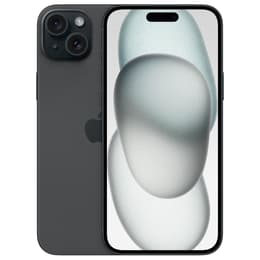
iPhone 15 Plus
iPhone 15 Plus
Starting at

Refurbished price:A$741.00

Versus A$1,399.00 new

See options

Ratings

The Samsung Galaxy A23, released in March 2022, and the Apple iPhone 15 Plus, launched in September 2023, represent distinct approaches to smartphone design and functionality. While both devices offer large displays and capable camera systems, they cater to different user ecosystems and priorities. The Galaxy A23 operates on the Android platform, emphasizing user customization and expandable storage, whereas the iPhone 15 Plus runs on Apple's iOS, known for its integrated ecosystem and robust performance. Key differentiators lie in their operating systems, processing power, display technology, and overall camera capabilities.

Scores

Durability

The longevity and build quality of a smartphone are crucial for long-term use, and these two devices present different profiles.

  • Release Timeline and Software Support: The Galaxy A23, released in March 2022, typically receives two major Android OS updates and four years of security updates. For instance, the 4G variant launched with Android 12 and was eligible for updates up to Android 14, while the 5G variant has been updated to Android 15. The iPhone 15 Plus, launched in September 2023, benefits from Apple's extended software support, generally receiving 5-7 years of major iOS updates, ensuring a longer period of access to the latest features and security patches.
  • Build Materials and Durability Features: The Galaxy A23 features a glass front protected by Gorilla Glass 5, combined with a plastic frame and back. The iPhone 15 Plus offers a more robust construction with a Ceramic Shield front, a color-infused glass back, and an aluminum frame. It also boasts an IP68 rating for water and dust resistance, allowing submersion up to 6 meters for 30 minutes.
  • Repairability: The Galaxy A23 is considered relatively repairable, with a score of 6.75 out of 10, allowing for easier replacement of components like the back plate and battery with appropriate tools. While specific repairability scores for the iPhone 15 Plus were not detailed, Apple has been improving repair options for its devices.

Release year

2022

2023

Compatible with latest Update

Yes

Yes

Operating system

Android

iOS

Foldable

No

No

Performance

Performance is a significant area of distinction, impacting everything from app responsiveness to gaming and multitasking.

  • Processor Capabilities and Responsiveness: The Galaxy A23 is powered by a processor designed for efficient everyday use, handling common applications and light multitasking smoothly. However, users might experience some sluggishness with more demanding applications or extensive multitasking, particularly with lower RAM configurations. The iPhone 15 Plus, featuring a high-performance chip, delivers brisk and fluid performance across all tasks, from intensive gaming to seamless app switching and video editing.
  • Storage and RAM Configurations: The Galaxy A23 offers storage options of 64GB or 128GB, with the added flexibility of expandable storage via a microSD card. It comes with 4GB, 6GB, or 8GB of RAM, with higher RAM options providing a smoother experience for multitasking. The iPhone 15 Plus provides internal storage options of 128GB, 256GB, or 512GB, but does not support expandable storage. It includes 6GB of RAM, which, combined with iOS optimization, ensures efficient multitasking.
  • Battery Life: The Galaxy A23 is equipped with a 5000 mAh battery, known for its excellent endurance, often providing up to two days of use with moderate activity. It supports 25W wired fast charging. The iPhone 15 Plus, with its 4383 mAh battery, offers exceptional battery life, frequently lasting more than a full day even with heavy usage, and often extending to two days for lighter users. It supports 20W wired fast charging and wireless charging.

Memory (GB)

4 GB

6 GB

Screen quality

The visual experience differs significantly between these two smartphones, primarily due to their display technologies.

  • Display Technology and Clarity: The Galaxy A23 features a 6.6-inch PLS LCD display with a resolution of 1080 x 2408 pixels, providing clear visuals for everyday content. The iPhone 15 Plus boasts a 6.7-inch Super Retina XDR OLED display with a higher resolution of 2796 x 1290 pixels, resulting in sharper images, deeper blacks, and more vibrant colors.
  • Refresh Rate and Smoothness: The Galaxy A23 offers a smoother scrolling experience with a 90Hz refresh rate for the 4G variant and a 120Hz refresh rate for the 5G variant. The iPhone 15 Plus maintains a standard 60Hz refresh rate.
  • Brightness and Special Features: The iPhone 15 Plus provides significantly higher peak brightness levels, reaching up to 2000 nits for outdoor viewing, which enhances visibility in bright sunlight. The Galaxy A23's LCD panel offers typical brightness for its technology. The iPhone 15 Plus also incorporates the Dynamic Island, an interactive area at the top of the display that adapts to show alerts and background activities.

Resolution

1080 x 2408

1290 x 2796

Screen type

PLS LCD

Super Retina XDR OLED

Audiovisual

Both devices offer multi-lens camera systems, but their photographic and videographic capabilities vary.

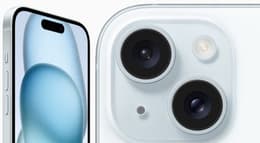
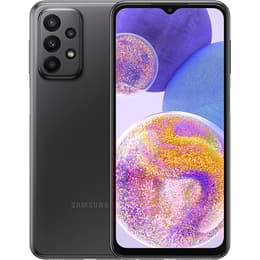
  • Rear Camera System: The Galaxy A23 features a quad-camera setup, including a 50MP main sensor with optical image stabilization (OIS), a 5MP ultrawide lens, a 2MP macro lens, and a 2MP depth sensor. The iPhone 15 Plus comes with a dual-camera system, featuring a 48MP main sensor with OIS that enables a 2x optical zoom equivalent, and a 12MP ultrawide lens.
  • Photography Performance: The Galaxy A23 delivers decent photos in well-lit conditions, and its OIS helps improve low-light shots, though the macro and depth sensors are often considered less impactful. The iPhone 15 Plus offers very good overall image quality, with improvements in low-light performance, accurate color reproduction, and sharp detail, enhanced by its Photonic Engine.
  • Video Recording Capabilities: The Galaxy A23 is capable of recording videos at up to 1080p resolution at 30 frames per second. The iPhone 15 Plus provides more advanced video features, including 4K recording at up to 60 frames per second, Cinematic mode, Action mode, and HDR video recording with Dolby Vision.
  • Front Camera: The Galaxy A23 includes an 8MP front-facing camera. The iPhone 15 Plus features a 12MP TrueDepth front camera with autofocus, supporting various portrait modes and 4K video recording.

Main camera

50 megapixels

48 megapixels

Front camera

8 megapixels

12 megapixels

Miscellaneous

Beyond core features, several practical elements contribute to the overall user experience of each device.

  • Connectivity and Ports: The Galaxy A23 supports 4G or 5G connectivity depending on the variant, Wi-Fi 5, and Bluetooth 5.0 or 5.1. It includes a USB-C port for charging and data transfer, and retains a 3.5mm headphone jack. The iPhone 15 Plus supports 5G, Wi-Fi 6E, and Bluetooth 5.3. It features a USB-C port for charging and data, but does not include a 3.5mm headphone jack.
  • Biometric Security: The Galaxy A23 utilizes a side-mounted fingerprint sensor for secure unlocking. The iPhone 15 Plus relies on Face ID, Apple's facial recognition system, for biometric authentication.
  • Physical Characteristics: The Galaxy A23 measures approximately 165.4 x 76.9 x 8.4 mm and weighs around 195 grams. The iPhone 15 Plus is slightly more compact in height and thinner, measuring about 160.9 x 77.8 x 7.8 mm and weighing around 201 grams. The Galaxy A23 has a plastic back and frame, while the iPhone 15 Plus features an aluminum frame and a glass back.

Weight

195 oz

201 oz

Screen size (in)

6.6

6.7

Network

4G

5G

SIM card

Dual Physical SIM

Physical SIM + eSIM

Carrier compatibility

Unlocked

Unlocked

User feedback highlights distinct strengths for both the Samsung Galaxy A23 and the iPhone 15 Plus. The Galaxy A23 is frequently praised for its exceptional battery life, often lasting up to two days on a single charge, and the inclusion of a 3.5mm headphone jack and expandable storage are often cited as practical advantages. Its 90Hz or 120Hz display (depending on the variant) also receives positive remarks for smoother visuals. However, some users note that its processor can exhibit sluggishness with demanding applications, and the overall camera quality, while decent, does not match higher-tier devices.

The iPhone 15 Plus consistently receives acclaim for its outstanding battery life, often surpassing many other smartphones in endurance. Its large, vibrant OLED display with high outdoor brightness is a significant draw, as is its powerful performance for all tasks and its very capable camera system. Common criticisms include its 60Hz refresh rate, which some users find less fluid than higher refresh rate displays on other devices, and the absence of a dedicated telephoto lens or a headphone jack.

Users prioritizing extended battery life, expandable storage, and the convenience of a headphone jack may find the Samsung Galaxy A23 well-suited to their needs. Conversely, individuals seeking top-tier performance, a superior display, advanced camera capabilities, and a longer software support lifespan will likely lean towards the iPhone 15 Plus. Both devices offer compelling features for different user profiles, and considering a quality-assured refurbished option can be an eco-friendly alternative for either model.

See all articles

Our recent comparisons