Compare models
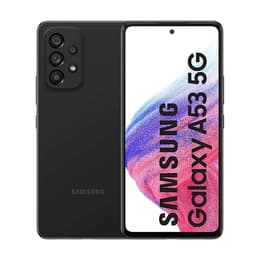
Galaxy A53 5G vs Galaxy A56
- 1-year warranty
- Free standard shipping
- Free 30-day returns
Differences at a glance
The Samsung Galaxy A53 5G (2022) and the Samsung Galaxy A56 (2025) are mid-range smartphones designed to deliver balanced everyday capabilities within Samsung's popular product lineup. While both devices share a focus on reliable functionality and modern connectivity, the Galaxy A56 introduces a refined processor, upgraded charging speeds, and a larger display compared to its predecessor. Both models operate on Android platforms with Samsung's customized interface overlay, though the newer model benefits from an extended software support window.
Available Models
Colour
Storage
Scores
Durability
When evaluating longevity, the Galaxy A53 5G and Galaxy A56 differ significantly in their release timelines and remaining software support windows, impacting their expected practical lifespan.
- Release timeline and software support: The Galaxy A53 5G debuted in 2022 with an established multi-year update commitment, while the newer Galaxy A56 benefits from a release date three years later in 2025, extending its software update lifespan further into the future.
- Repairability and build durability: Both devices feature dust and water resistance ratings alongside standard glass-and-plastic construction, though repair accessibility for internal components remains comparable across both generations.
- Expected practical lifespan: Users seeking maximum software longevity and security patch currency will find the newer hardware configuration better equipped to remain current over extended ownership periods.
Release year
2022
2025
Operating system
Android
Android
Foldable
No
No
Performance
Performance capabilities vary noticeably between these two generations, affecting multitasking efficiency and general system responsiveness during daily tasks.
- Processor capabilities: The Galaxy A53 5G handles everyday navigation, web browsing, and moderate apps reliably, whereas the Galaxy A56 delivers faster app loading speeds and smoother transitions during demanding multitasking and modern mobile gaming.
- Storage and memory configurations: Both models offer practical internal storage choices alongside multi-gigabyte RAM allocations, though memory management handles background tasks more fluidly on the newer device.
- Battery behavior: Each phone includes a large capacity battery designed to last through a standard day of mixed usage, but the Galaxy A56 supports faster maximum charging speeds to reduce downtime when replenishing power.
Screen quality
Display characteristics shape the visual experience on both smartphones, offering bright and clear panels for media consumption and daily navigation.
- Display technology: Both devices utilize vibrant OLED panel technology that produces deep black levels and high contrast ratios, though the Galaxy A56 expands slightly to a 6.7-inch screen size compared to the 6.5-inch panel on the Galaxy A53 5G.
- Refresh rate and smoothness: Both screens support a 120 Hz refresh rate, ensuring fluid scrolling through web pages and responsive touch interactions during daily use.
- Outdoor visibility: High peak brightness levels on both panels allow content to remain legible under direct sunlight, though newer glass protection materials on the Galaxy A56 enhance scratch resistance.
Resolution
1080 x 2400
1080 x 2340
Audiovisual
Optics and media playback capabilities differ across generations, influencing how each device handles everyday photography and audio output.
- Camera hardware: The Galaxy A53 5G relies on a high-resolution quad-camera arrangement, while the Galaxy A56 features a revised triple-camera setup utilizing an updated primary sensor for improved low-light clarity and detail retention.
- Video recording: Both smartphones support high-definition video capture with stabilization features to reduce shake, though processing algorithms on the newer model manage challenging lighting conditions more effectively.
- Audio and media consumption: Built-in stereo speakers on both devices provide clear sound for casual video playback and calls, though neither model includes a traditional 3.5mm headphone jack.
Miscellaneous
Practical physical attributes and connectivity standards define how these smartphones integrate into daily routines and travel requirements.
- Connectivity and ports: Both models support 5G cellular networks, modern Wi-Fi standards, and Bluetooth pairing, utilizing USB-C ports for charging and data transfer.
- Biometric security: Each device incorporates secure authentication methods, utilizing optical fingerprint sensors integrated beneath the display alongside facial recognition options.
- Physical dimensions: The Galaxy A56 features a slightly slimmer profile despite its larger screen estate, while the Galaxy A53 5G maintains a marginally more compact footprint that some users find easier to handle with one hand.
Weight
189 oz
200 oz
Screen size (in)
6.5
6.7
Network
5G
4G
SIM card
Physical SIM
Physical SIM + eSIM
Carrier compatibility
Unlocked
Unlocked
What the community thinks
Community discussions on platforms like Reddit indicate that users appreciate both devices for providing reliable daily performance, dependable battery endurance, and fluid high-refresh-rate displays without requiring a flagship investment. Common criticisms for the older Galaxy A53 5G center around occasional stutter during heavy multitasking, while discussions regarding the Galaxy A56 sometimes note its larger physical footprint as less suited for smaller pockets. Overall user consensus highlights that both models fulfill standard communication and multimedia needs efficiently.
Users prioritizing extended software longevity, faster charging speeds, and a more responsive processor for modern apps may prefer the Galaxy A56, while users seeking a slightly more compact daily device with reliable core functions will find the Galaxy A53 5G well-suited to their needs. For those looking at sustainable choices, a quality-assured refurbished option provides an eco-friendly way to acquire either device while reducing electronic waste. Ultimately, the right choice depends on individual preferences regarding device dimensions and performance headroom rather than any absolute superiority.