
Compare models
Galaxy A33 5G vs Galaxy A34
- 1-year warranty
- Free standard shipping
- Free 30-day returns
Differences at a glance
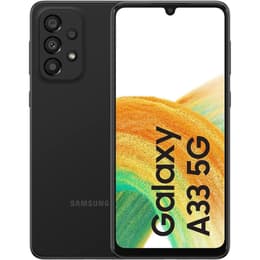
The Samsung Galaxy A33 5G (2022) and the Samsung Galaxy A34 (2023) are consecutive generations of mid-range smartphones designed to offer reliable everyday features. While they share similar battery capacities and core software ecosystems, the Galaxy A34 introduces a larger screen, a faster refresh rate, and updated processing hardware. Both devices run Samsung's custom interface over the Android operating system, providing a familiar layout for users navigating daily tasks, media consumption, and communication.
Available Models
Colour
Storage (GB)
Scores
Durability
When evaluating the long-term viability of these two devices, software support timelines and hardware robustness are key considerations for everyday users.
- Software support duration: Both models benefit from Samsung's extended update policy, though the newer Galaxy A34 receives software updates for an additional year past its predecessor's timeline.
- Repairability and build: Both units feature durable glass fronts protected by sturdy layers, alongside reliable dust and water resistance ratings that safeguard against daily accidents.
- Expected lifespan: The combination of large internal energy reserves and long-term operating system patches ensures that both options remain functional for years of standard daily use.
Release year
2022
2023
Compatible with latest Update
Yes
Yes
Operating system
Android
Android
Foldable
No
No
Performance
Handling daily multitasking, app switching, and casual gaming depends heavily on internal optimization and memory allocation across both smartphones.
- System responsiveness: The Galaxy A34 utilizes a more modern internal processor that handles demanding applications and rapid multi-window switching with greater thermal efficiency than the older Galaxy A33 5G.
- Battery behavior: Both devices house identical battery capacities that easily last through a full day of standard messaging, web browsing, and media streaming under normal conditions.
- Multitasking capacity: Configurable with matching RAM tiers, both models manage background apps adequately, though the updated processor architecture in the newer model yields smoother transitions during heavy usage peaks.
Screen quality
Display characteristics differ noticeably in physical dimensions and visual fluidity, altering how users experience media and navigation.
- Refresh rate and smoothness: The Galaxy A34 features a faster 120Hz display refresh rate compared to the 90Hz panel on the Galaxy A33 5G, resulting in more fluid scrolling through web pages and social feeds.
- Panel technology and size: Both utilize vibrant Super AMOLED display panels with crisp high-definition resolution, while the Galaxy A34 offers a slightly larger physical screen area for media viewing.
- Outdoor visibility: High peak brightness levels on both screens ensure that text and images remain legible under direct sunlight during outdoor travel or commuting.
Resolution
1080 x 2400
1080 x 2340
Screen type
Super AMOLED
Super AMOLED
Audiovisual
Capturing everyday moments and enjoying multimedia output relies on distinct rear camera layouts and internal audio hardware.
- Camera versatility: Both models feature primary lenses equipped with optical image stabilization for steady shots, alongside ultra-wide options for landscape photography, though the Galaxy A34 streamlines its secondary sensor selection.
- Low-light performance: Integrated night processing modes help both devices reduce noise in dim environments, rendering clear photos during evening outings.
- Media and audio output: Built-in stereo speakers on both smartphones provide balanced sound delivery for hands-free calls, casual video viewing, and listening to podcasts without external headphones.
Main camera
48 megapixels
48 megapixels
Front camera
13 megapixels
13 megapixels
Miscellaneous
Practical physical attributes and connectivity standards shape how comfortable each device feels during daily handling and transit.
- Physical dimensions and weight: The Galaxy A33 5G is slightly more compact and lighter, making it easier to handle for users with smaller hands, whereas the Galaxy A34 provides a broader footprint to accommodate its larger screen.
- Connectivity and ports: Both models support modern 5G cellular networks, reliable Wi-Fi standards, and USB Type-C connectivity for charging and data transfer.
- Biometric security: Secure unlocking is handled via responsive fingerprint sensors integrated directly into the display or side frame, complemented by facial recognition options.
Weight
186 oz
199 oz
Screen size (in)
6.4
6,6
Network
5G
5G
SIM card
Physical SIM
Physical SIM
Carrier compatibility
Unlocked
Unlocked
What the community thinks
User feedback from online communities highlights distinct preferences between these two devices. Owners of the Galaxy A33 5G frequently praise its compact handling and reliable all-day battery performance, while noting that its screen refresh rate feels slightly less fluid than newer standards. Conversely, users gravitate toward the Galaxy A34 for its smoother visual output and snappier processing speeds during heavy multitasking, though some point out that its larger physical chassis takes up more space in pockets.
Users prioritizing compact handling and a slightly smaller pocket footprint may prefer the Galaxy A33 5G, while users prioritizing a faster screen refresh rate and enhanced processing fluidity will lean toward the Galaxy A34. Choosing a quality-assured refurbished option through platforms like Back Market provides an eco-friendly, sustainable way to acquire either device while reducing electronic waste. Ultimately, both models deliver capable mid-range performance tailored to different everyday usability preferences.