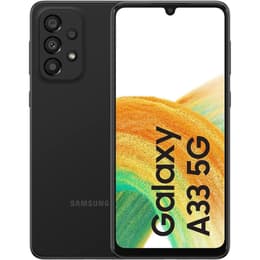

Galaxy A33 5G vs Google Pixel 9

Galaxy A33 5G
Galaxy A33 5G
Starting at

Refurbished price:A$206.00

Versus A$495.00 new

See options
Google Pixel 9
Google Pixel 9
Starting at

Refurbished price:A$717.00

Versus A$1,349.00 new

See options

The Samsung Galaxy A33 5G, released in April 2022, and the Google Pixel 9, launched in August 2024, represent distinct offerings within the Android smartphone landscape. While both devices operate on the Android platform, they cater to different user expectations, primarily differentiated by their release timelines, performance capabilities, and software philosophies. The Galaxy A33 5G positions itself as a robust mid-range option, whereas the Pixel 9 embodies Google's vision for a premium smartphone experience, emphasizing advanced computational features and a streamlined software approach.

Scores

Durability

The practical lifespan of a smartphone is significantly influenced by its release age and the manufacturer's commitment to software updates and physical durability.

  • Release Timeline: The Galaxy A33 5G was introduced in April 2022, making it an older device compared to the Google Pixel 9, which launched in August 2024. This age difference inherently impacts the remaining period of official software support.
  • Software Longevity: Samsung typically provides four generations of Android OS updates and five years of security updates for the A33 5G, meaning its software support will conclude sooner than the Pixel 9. Google, on the other hand, offers an extended commitment of seven years of OS and security updates for the Pixel 9, ensuring a considerably longer period of up-to-date software and security features.
  • Physical Durability: The Galaxy A33 5G features an IP67 rating for dust and water resistance and is protected by Gorilla Glass 5 on the front. The Pixel 9 boasts an IP68 rating, indicating a higher level of protection against dust and water immersion, and utilizes the more advanced Gorilla Glass Victus 2 on both its front and back, contributing to enhanced scratch and drop resistance.

Release year

2022

2024

Compatible with latest Update

Yes

Yes

Operating system

Android

Android

Foldable

No

No

Performance

Performance is a key differentiator, with the newer Pixel 9 offering a more advanced and responsive user experience compared to the Galaxy A33 5G.

  • Processing Power: The Galaxy A33 5G handles everyday tasks such as browsing, social media, and light gaming smoothly. However, when running more demanding applications or engaging in intensive multitasking, users may notice occasional delays or slower loading times. The Pixel 9, equipped with a more powerful and recent processor, delivers a consistently fluid experience, excelling in demanding applications, complex multitasking, and graphically intensive games.
  • System Responsiveness: The Pixel 9's hardware and software optimization result in quicker app launches, smoother transitions between applications, and more efficient handling of background processes. The Galaxy A33 5G, while capable, offers a more modest level of responsiveness suitable for general use.
  • Memory and Storage: The Galaxy A33 5G comes with various RAM configurations (4GB, 6GB, or 8GB) and 128GB or 256GB of internal storage, with the added flexibility of expandable storage via a microSD card. The Pixel 9 typically features 12GB of RAM and storage options of 128GB or 256GB, providing ample memory for advanced tasks and applications, though it does not offer expandable storage.

Memory (GB)

4 GB

12 GB

Screen quality

The visual experience on both devices is shaped by their display technology, resolution, and brightness capabilities.

  • Display Technology and Clarity: The Galaxy A33 5G features a 6.4-inch Super AMOLED display, offering vibrant colors and deep blacks, with a resolution of 1080 x 2400 pixels. The Pixel 9 comes with a slightly smaller 6.3-inch Actua OLED display, also providing excellent color reproduction and contrast, with a similar 1080 x 2424 pixel resolution.
  • Refresh Rate and Smoothness: The Galaxy A33 5G has a 90Hz refresh rate, which provides a noticeably smoother scrolling and viewing experience compared to standard 60Hz displays. The Pixel 9 elevates this with a 120Hz refresh rate, resulting in even more fluid animations and a highly responsive feel, particularly beneficial for gaming and fast-paced content.
  • Brightness Levels: For outdoor visibility, the Pixel 9 offers significantly higher peak brightness, reaching up to 2700 nits, making content easily viewable even in direct sunlight. The Galaxy A33 5G has a peak brightness of around 800 nits, which is adequate for most indoor and outdoor conditions but may struggle in very bright environments.

Resolution

1080 x 2400

1080 x 2424

Screen type

Super AMOLED

OLED

Audiovisual

Both smartphones offer capable camera systems, but they approach photography with different strengths and feature sets.

  • Rear Camera System: The Galaxy A33 5G is equipped with a versatile quad-camera setup, including a 48MP main sensor with optical image stabilization (OIS), an 8MP ultrawide lens, a 5MP macro lens, and a 2MP depth sensor. This configuration allows for a range of photographic styles. The Pixel 9 features a dual-camera system, highlighted by a 50MP main sensor with OIS and a 48MP ultrawide lens with autofocus. Google's strength lies in its computational photography, which enhances image quality through software processing.
  • Photography Performance: The Galaxy A33 5G delivers good everyday photos with decent detail and color accuracy, and its OIS helps in reducing blur. The Pixel 9 is renowned for its consistent image quality across various lighting conditions, producing sharp, well-exposed, and color-accurate photos, particularly excelling in challenging low-light scenarios due to its advanced image processing.
  • Video Recording and Audio: Both devices are capable of recording 4K video, with the Galaxy A33 5G supporting 4K at 30 frames per second (fps) and the Pixel 9 offering 4K at up to 60fps, providing smoother video capture. The Pixel 9 generally offers superior microphone quality for recordings and calls, and its stereo speakers provide a richer audio experience for media consumption.

Main camera

48 megapixels

50 megapixels

Front camera

13 megapixels

10.5 megapixels

Miscellaneous

Beyond core features, several practical elements contribute to the overall user experience and device utility.

  • Connectivity: Both phones support 5G connectivity for fast mobile data. The Galaxy A33 5G includes Wi-Fi 5 (802.11ac) and Bluetooth 5.1. The Pixel 9 features more advanced connectivity with Wi-Fi 7 and Bluetooth 5.4, offering potentially faster and more stable wireless connections.
  • Ports and Sensors: Both devices utilize a USB-C port for charging and data transfer, though the Pixel 9 features the faster USB-C 3.2 standard compared to the Galaxy A33 5G's USB-C 2.0. Neither phone includes a traditional 3.5mm headphone jack. For security, both offer in-display fingerprint sensors, with the Pixel 9 also incorporating face unlock capabilities.
  • Build Materials and Handling: The Galaxy A33 5G has a glass front (Gorilla Glass 5) and a plastic back and frame, contributing to its lighter weight of 186g. The Pixel 9 features a more premium construction with Gorilla Glass Victus 2 on both the front and back, and an aluminum frame, weighing 188g. The Pixel 9 is also slightly more compact in its dimensions, potentially offering a more comfortable one-handed grip for some users.

Weight

186 oz

198 oz

Screen size (in)

6.4

6.3

Network

5G

5G

SIM card

Physical SIM

Physical SIM + eSIM

Carrier compatibility

Unlocked

Unlocked

User feedback often highlights the Galaxy A33 5G's strong battery life and its capable display as significant advantages for its segment. Some users, however, note that its processor performance can feel less snappy compared to newer or higher-tier devices, and the absence of a headphone jack was a point of adjustment for some.

The Google Pixel 9 generally receives praise for its exceptional camera performance, particularly its computational photography capabilities that deliver impressive results in various conditions. Users also appreciate its clean Android experience, long-term software support, and the integration of advanced AI features. Criticisms sometimes point to its processor, which, while powerful, may not always match the raw benchmark scores of some competing flagship chipsets, and some users have reported inconsistent battery life under heavy usage.

For users prioritizing extended software support, cutting-edge camera technology, and a premium, compact build with advanced AI features, the Google Pixel 9 will be well-suited. Its superior display and faster performance cater to those who demand a highly responsive and visually rich smartphone experience. Conversely, users seeking a reliable device with a long-lasting battery, a versatile camera for everyday use, and expandable storage, without needing the absolute latest in processing power, may find the Galaxy A33 5G to be a practical choice. Both devices are available as quality-assured refurbished options, providing an eco-friendly alternative for consumers.


See all articles

Our recent comparisons